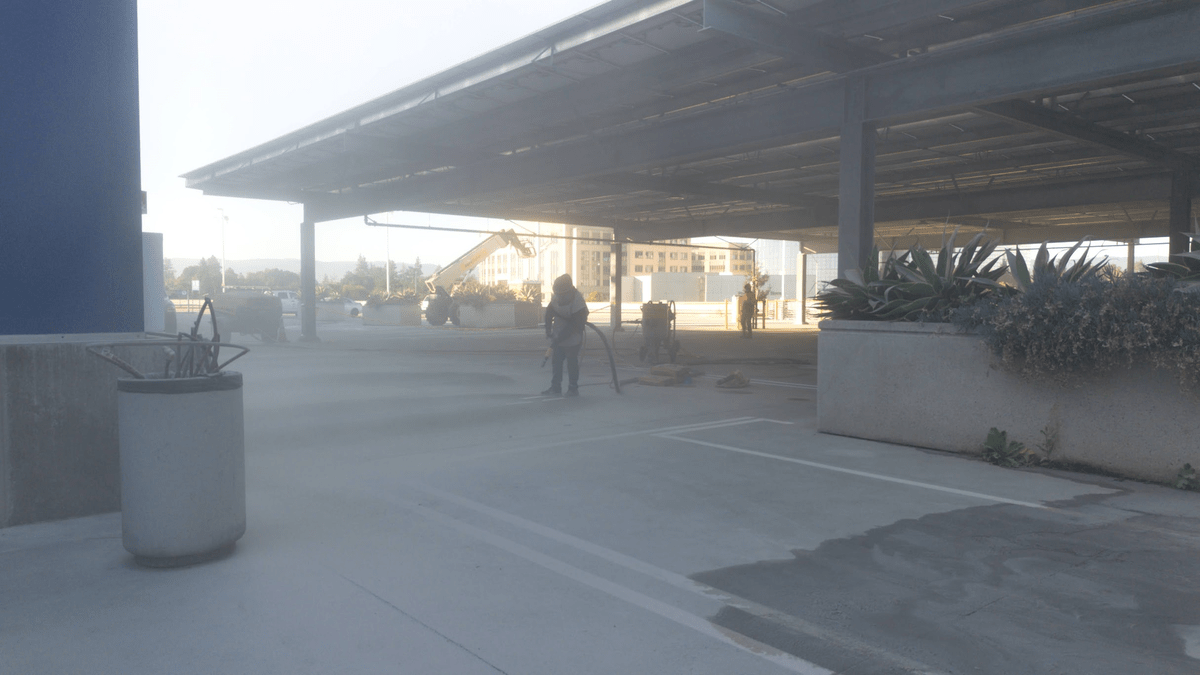
Concrete dusting represents one of the most frustrating surface defects encountered in commercial warehouses, industrial facilities, and parking structures. Characterized by the perpetual formation of a fine, chalky white powder across the floor, this condition is often mistaken for ambient dirt or general jobsite debris. In reality, concrete dusting is the physical disintegration of a weakened wear layer on the slab itself. Every pass of a forklift, pallet jack, or industrial sweeper shears micro-particles from the top few millimeters of the surface, contaminating stored inventory, degrading indoor air quality, and clogging sensitive mechanical filters.
Left unaddressed, a dusting slab continues to deteriorate under normal operational traffic, eroding the protective paste and exposing the underlying aggregate to accelerated abrasion and chemical staining. Remediating the issue requires looking past quick cosmetic fixes and identifying the placement, finishing, and curing mechanisms that created the weak surface layer in the first place. The following technical guide, reviewed by We Love Paving’s field operations team (CSLB Licensed #1049649, C12 Earthwork and Paving), outlines how weak concrete surfaces form, how to test the severity of degradation on-site, and how commercial property managers can implement permanent structural fixes.
Understanding Concrete Dusting: What It Is and Why Sweeping Won’t Stop It
Concrete dusting is the progressive breakdown of a weak, porous, and under-hydrated cement paste layer on the slab surface under abrasive traffic. Rather than an accumulation of external debris, this powder originates entirely from the slab itself. When concrete lacks surface hardness, routine mechanical friction such as rubber forklift tires, pedestrian footpaths, or routine maintenance equipment grinds the brittle surface paste into micro-fine calcium carbonate and unbonded cement particles that become continuously airborne.
Facility managers frequently attempt to manage the symptom by increasing dry sweeping schedules or deploying industrial vacuums, only to find the dust reappears within hours. Sweeping fails because removing the loose powder simply uncovers the next fragile layer of unhardened cement paste underneath. Each cleaning cycle mechanically strips the loosened micro-layer, exposing additional porous material that breaks down under the next load cycle.
Dusting differs fundamentally from other common surface pathologies like scaling or spalling. Concrete scaling involves the local flaking or peeling of frozen or chemically attacked mortar, while spalling represents a deeper, structural breakout typically driven by internal rebar corrosion or expansive sub-base pressures. Dusting, by comparison, is an abrasive wear-layer failure localized to the upper wear zone. In commercial environments, this persistent particulate matter causes severe operational overhead: it settles on finished goods, wears out electrical motors in material-handling equipment, fouls air exchange filtration systems, and creates slippery, low-traction walking zones that compromise workplace safety.

Root Causes During Placement and Curing: How Weak Surfaces Form
The primary physical cause of concrete dusting is an excessively high water-to-cement (w/c) ratio in the uppermost 3 to 5 millimeters of the slab, almost always caused by premature finishing operations while bleed water is still present on the surface. When fresh concrete is poured, heavier sand and aggregate settle toward the bottom of the forms, forcing displaced mix water to migrate upward toward the surface, a natural process known as bleeding. If finishing crews begin floating or troweling before this bleed water has completely evaporated, the mechanical action of the blades works that excess surface water back into the top layer of cement paste.
According to American Concrete Institute guidelines (ACI 302.1R), reintroducing bleed water into the wear zone dilutes the cement paste, spike-elevating the local water-cement ratio far beyond the engineered mix design. In highway and heavy commercial paving, Caltrans Standard Specifications (Section 90) strictly limits water-to-cement ratios typically maintaining them between 0.40 and 0.45 to ensure dense particle packing and high compressive durability. When finishing crews work water back into the paste or commit the jobsite error of “blessing the slab” (sprinkling additional water onto stiffening concrete to ease troweling), the resulting wear layer forms a soft, chalky substance known as laitance, which lacks compressive strength and abrasive resistance.
Inadequate curing practices and adverse ambient conditions further exacerbate surface dusting. If a newly poured slab dries out too rapidly, the chemical reaction between water and Portland cement halts prematurely before dense calcium silicate hydrate (C-S-H) crystals can fully form. Maintaining a critical concrete curing timeline ensures that the surface maintains sufficient moisture to develop its intended design strength. In unconditioned industrial spaces or cold-weather pours, operating unvented fuel-burning heaters releases excessive carbon dioxide (CO2) over wet concrete. This triggers early carbonation, reacting with fresh calcium hydroxide to create a chalky calcium carbonate layer that disintegrates under light abrasion.
Field Testing: Diagnosing Dusting Severity Before Selecting a Treatment
Facility managers can determine whether concrete dusting is confined to a micro-thin surface film or indicates deep matrix failure by conducting three straightforward field diagnostic tests: an industrial tape pull test, a scratch hardness evaluation, and an acid reactivity check. Establishing the actual depth and structural integrity of the affected zone prevents property owners from wasting capital on topical coatings that will inevitably peel off poorly prepared substrates.
The industrial tape test measures the rate of ongoing surface attrition and loose particle volume. To perform this check, press a strip of heavy-duty commercial vinyl duct tape or aggressive adhesive packaging tape firmly onto a thoroughly swept, dry test section. Burnish the tape down with a hard rubber roller or firm thumb pressure to ensure direct contact with the paste, then pull the tape away sharply at a 90-degree angle. If the adhesive face is densely coated with white, powdery silt and granular paste fragments, the surface exhibits active laitance breakdown and will reject direct paint or thin-film sealer applications.
| Diagnostic Test | Field Procedure | Structural Indicator |
|---|---|---|
| 1. Industrial Tape Adhesion Test | Firmly apply and rapidly strip aggressive vinyl adhesive tape. | Heavy white residue = Active laitance failure. |
| 2. Scratch Hardness Test (Mohs Scale) | Scratch surface using steel picks calibrated from Mohs 3 to Mohs 7. | Scratches below Mohs 4 = Inadequate compressive paste density. |
| 3. Dilute Acid Reactivity Test | Apply drops of 10% muriatic or phosphoric acid solution. | Violent foaming = Highly porous, unbound calcium compounds. |
The scratch hardness test establishes the mechanical density of the remaining concrete. Using a standard Mohs hardness scratch kit or a hardened steel scriber (which typically registers around 5.5 on the Mohs scale), attempt to score the surface with moderate, consistent downward pressure. High-strength commercial concrete finished to industrial standards should resist scratching below Mohs 5 to 6. If a steel pick rated at Mohs 3 or 4 easily furrows into the surface and produces loose powder, the paste matrix has degraded significantly below standard operational thresholds. Finally, applying several drops of a 10% dilute muriatic or phosphoric acid solution reveals the density of the binder. Violent, instantaneous effervescence and rapid liquid absorption confirm a hyper-porous surface structure with high levels of unbound calcium, signaling that mechanical grinding or deep-penetrating chemical intervention is mandatory.
Chemical and Mechanical Remediation: Penetrating Densifiers vs. High-Build Coatings
Remediating a dusting concrete floor requires either chemically solidifying the existing porous cement paste with penetrating silicate densifiers or mechanically profiling the surface to receive an impervious polymer coating system. Applying a standard off-the-shelf latex paint or non-breathable thin acrylic sealer directly over a dusting floor is guaranteed to fail; the coating bonds only to the loose laitance layer and peels off under traffic within months.
Penetrating chemical densifiers represent the most cost-effective and permanent solution for slabs where dusting is confined to the upper 1 to 2 millimeters. Typically formulated with lithium, sodium, or potassium silicates, these clear liquids do not form a topical film. Instead, they soak deeply into the micro-capillaries of the concrete to initiate a secondary chemical reaction with unhydrated free calcium hydroxide (Ca(OH)2) left behind by the original hydration reaction within the cement process. This reaction precipitates insoluble calcium silicate hydrate (C-S-H) the exact crystalline structure that gives concrete its compressive hardness filling the microscopic voids, locking down loose particulates, and permanently stopping dust generation from within the slab matrix.
Where facilities demand chemical resistance, seamless sanitation, or high-visibility reflective surfaces, high-build epoxy or polyurethane coatings provide a heavy-duty barrier. However, coating installations require aggressive mechanical surface preparation to remove the fragile laitance entirely. Contractors must utilize diamond grinding or shot blasting to achieve an International Concrete Repair Institute (ICRI) Concrete Surface Profile (CSP) of CSP 2 to CSP 4. Attempting to install high-performance resins over an unprofiled, dusting substrate traps the weak paste underneath, leading to massive sheet delamination under the torsional stress of turning forklift wheels.
Lithium / Sodium Densifiers
CSP 1Lithium / Sodium Densifiers
TechnicalPenetrating Siliconate Sealers
CSP 1Penetrating Siliconate Sealers
TechnicalHigh-Build Epoxy Systems
CSP 2–3High-Build Epoxy Systems
TechnicalUrethane Mortar Overlays
CSP 4–5Urethane Mortar Overlays
TechnicalWhen Remediation Fails: Structural Thresholds That Require Full Slab Replacement
Surface densifiers and polymer resurfacing systems cannot rescue a concrete slab that has suffered structural failure throughout its cross-section. When dusting is simply the superficial symptom of comprehensive concrete batch failure such as extreme over-watering at the ready-mix truck, severe aggregate segregation, or freezing during initial set the slab will lack the internal compressive resistance required to support wheel loading, regardless of topical chemical treatments.
A primary threshold indicating that surface remediation will fail is the depth of paste deterioration. If exploratory core drilling or mechanical scraping reveals that the soft, friable paste extends deeper than 1/4 inch (6 mm), liquid densifiers cannot penetrate deeply enough to consolidate the mass. Applying an overlay or epoxy atop deep, poorly bonded material causes the entire repair to shear away at the weak interface under dynamic axle loads. Similarly, if the slab exhibits widespread hollow sounds under chain dragging, structural cracking, or ongoing subgrade settlement, surface treatments will simply mask a deteriorating foundation that will soon crack open.
Diagnostic: Rehabilitate vs. Replace
Is Dusting Limited to the Upper 1–2 mm?
When core test reports demonstrate that in-place compressive strength falls substantially below commercial engineering specifications (such as a specified 4,000 psi mix testing at less than 2,200 psi), continuing to patch the surface creates recurring operating costs and dangerous liabilities. In these scenarios, the only financially sound decision is engaging commercial concrete services to execute saw-cutting, subgrade stabilization, and full structural repouring designed to carry real-world industrial loads.
Long-Term Prevention Protocols for Future Commercial Concrete Pours
Preventing concrete dusting requires strict mix design and placement controls. Commercial slabs demand low water-cement ratios between 0.40 and 0.45. Using polycarboxylate admixtures achieves high slump and pumpability without weakening surface hardness.
Finishing crews must never trowel bleed water back into the slab or spray water to ease finishing. Troweling should only begin once the surface sheen vanishes and the slab leaves less than a 1/4-inch footprint.
Aligning pours with optimal environmental conditions to pour concrete prevents rapid moisture loss from sun and wind. This stops crews from improperly re-wetting the stiffening surface.
Immediate curing per ASTM C309 using membrane-forming compounds or seven days of wet blankets ensures full hydration. These field practices eliminate dusting at the source, creating durable floors built for heavy industrial traffic.