Proper concrete curing determines whether a freshly poured commercial slab or driveway achieves its full structural design strength or suffers premature surface degradation, cracking, and spalling. While concrete may appear dry to the touch within hours of finishing, structural strength relies on a continuous chemical reaction rather than moisture evaporation. Allowing premature vehicular loads or failing to manage environmental moisture during early hydration compromises pavement integrity, leading to costly subbase repairs and shortened service lifespans.
Understanding exact curing milestones enables property managers, commercial developers, and facility directors to schedule operational reopening without risking surface damage. Curing requirements vary substantially depending on design mix specifications, compressive strength requirements (PSI), and local ambient exposure. Establishing a structured wait-time protocol ensures that foot traffic, light passenger vehicles, and heavy commercial loads access the pavement only when internal structural capacity meets established safety margins.
When Can You Walk or Drive on Fresh Concrete?
The progression of compressive strength gain follows a predictable engineering curve measured through compressive strength testing under ASTM C39 guidelines. During the initial 24 to 48 hours following placement, concrete undergoes initial setting and early hardening. Foot traffic, including pedestrian movement and light maintenance personnel, is typically safe after 24 to 48 hours, provided the surface has achieved initial set and exhibits no surface tackiness or indentation risk under point loads.
Light vehicular traffic, such as passenger cars, SUVs, and light pickup trucks weighing under 6,000 pounds Gross Vehicle Weight Rating (GVWR), requires a minimum curing period of 7 days. By day 7, standard concrete mixes formulated to achieve 3,000 to 4,000 PSI nominal strength at 28 days will typically reach approximately 65% to 70% of their total specified compressive strength (f’c). Accessing the surface prior to the 7-day mark risks micro-fracturing along the upper paste layer and edge ravelling under wheel turning forces.
Heavy commercial traffic, including loaded refuse trucks, delivery vehicles, semi-trailers, and heavy construction machinery, must be restricted for a full 28-day curing cycle. Concrete reaches its full design compressive strength (100% f’c) at 28 days under standard curing conditions. Premature exposure to heavy axle loads before full hydration induces sub-surface shear stress, leading to structural cracking, joint edge spalling, and subgrade deflection. For projects requiring faster access, high-early-strength concrete mixes utilizing Type III Portland cement or chemical accelerators can achieve 70% strength within 3 to 7 days, but standard commercial slabs require strict adherence to the 28-day rule.
- 24 to 48 Hours: Safe for foot traffic, light pedestrians, and hand-pushed equipment.
- 7 Days: Safe for passenger cars, light trucks, and light utility vehicles (approx. 70% PSI strength reached).
- 28 Days: Full design compressive strength reached; safe for heavy commercial trucks, dumpsters, and industrial traffic.
Concrete Curing vs. Drying: Understanding Chemical Hydration
A common misconception among property owners is that concrete hardens as it dries out. In structural materials engineering, concrete does not harden through drying; it hardens through hydration, a complex exothermic chemical reaction between Portland cement and water. When water mixes with cement, it triggers the formation of calcium silicate hydrate (C-S-H) crystals. These microscopic crystalline structures interlock and bind the fine aggregate (sand) and coarse aggregate (crushed stone or gravel) into a solid, impermeable mass.
If water evaporates from the concrete matrix too quickly during early stages, the hydration process stops prematurely due to a lack of unreacted water. This chemical arrest leaves unhydrated cement particles, resulting in a porous, weak surface layer with low abrasion resistance and reduced compressive strength. Proper curing requires retaining sufficient internal moisture within the slab to allow C-S-H crystal formation to continue uninterrupted throughout the critical initial strength-gain phase.
Maintaining an optimal water-cement ratio (w/c), typically between 0.40 and 0.45 for commercial exterior pavements, ensures long-term durability. Excess water added during batching increases workability but creates internal capillary voids as free water escapes, lowering overall PSI. Conversely, premature surface drying causes differential shrinkage between the top surface and the underlying mass, generating tensile stresses that manifest as plastic shrinkage cracks. Continuous moisture retention or liquid membrane applications ensure hydration proceeds uniformly throughout the entire cross-section of the slab.
Regional California Climate Impacts: NorCal Microclimates vs. SoCal >100°F Heat
Executing concrete projects across California requires adapting curing protocols to stark regional climate variations. Paving operations in Southern California face extreme ambient conditions, particularly in inland desert regions such as the Inland Empire, Coachella Valley, and Imperial County. During summer months, ambient temperatures frequently exceed 100°F (38°C), accompanied by low relative humidity and high wind velocities.
Under these conditions, surface evaporation accelerates dramatically, requiring rigorous monitoring against critical engineering thresholds:
In contrast, Northern California presents distinct microclimatic challenges between coastal zones and inland valleys. In the San Francisco Bay Area and coastal counties, cool marine fog, high relative humidity, and ambient temperatures hovering between 50°F and 65°F slow down the chemical hydration rate. Lower ambient temperatures delay setting times and strength development, requiring extended formwork retention and longer wait times before allowing traffic. Meanwhile, Northern California’s Sacramento Valley and Central Valley experience summer heat patterns similar to inland SoCal, with temperatures exceeding 95°F to 100°F that demand immediate moisture retention controls.
Essential Concrete Curing Methods and Caltrans Standards
Commercial paving installations across California must adhere to strict public works standards, such as those governed by Caltrans Section 90-1.03B, to guarantee structural longevity. These engineering specifications mandate a continuous curing period of at least 7 days for structural concrete and pavements, or until the concrete achieves a minimum of 70% of its specified 28-day compressive strength (f’c). Adopting professional curing methods ensures compliance with state standards and maximizes pavement life.
Liquid membrane-forming curing compounds meeting ASTM C309 standards represent the most prevalent method for commercial concrete paving. Liquid compounds are sprayed onto the surface immediately following final finishing and disappearance of the surface bleed water sheen. For high-temperature applications, such as Inland Empire commercial lots, Caltrans specifies white-pigmented curing compounds (Type 2, Class B), which form an impermeable membrane while reflecting heat to maintain lower internal core temperatures. On structural slabs or non-pigmented installations, clear or fugitive dye compounds (Type 1) are utilized.
Wet curing techniques provide superior hydration quality by continuously maintaining surface moisture, though they require greater labor supervision:
- Burlap and Moist Coverings: Saturated burlap or cotton mats are placed directly over the concrete surface and kept continuously wet with continuous soaking hoses for at least 7 days.
- Impervious Sheet Curing: Polyethylene film or waterproof paper conforming to ASTM C171 is laid over the wet concrete surface and sealed along the edges to trap evaporated moisture, creating a self-humidifying environment.
- Curing Compounds (ASTM C309): Membrane spray applications that form a seal over fresh concrete, eliminating the need for continuous water application in large-scale commercial paving.
Working with experienced contractors who provide professional commercial concrete paving services ensures that curing compounds and moisture barriers are applied at correct coverage rates specified by project engineers.
Control Joints, Surface Sealing, and Protecting New Pavement
Managing concrete during the curing cycle involves precise mechanical timing beyond moisture retention. As concrete hydrates and undergoes drying shrinkage, internal tensile stresses develop. To prevent unorganized, unsightly cracking across the slab, contractors install contraction joints, also known as control joints, to create weakened planes where cracking occurs predictably beneath the surface.
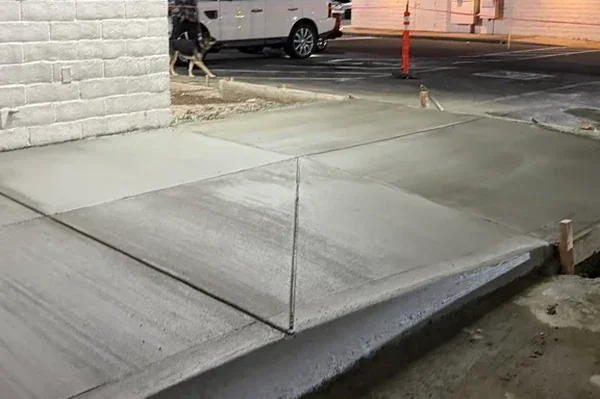
Joint cutting timing is critical and occurs during the early curing window, typically between 4 and 12 hours after pouring, once the concrete is hard enough to resist raveling or dislodging aggregate under the saw blade, but before internal thermal shrinkage stresses exceed the concrete’s early tensile strength. Coordinating saw cutting with proper curing protocols preserves the structural load transfer across the slab. Integrating precise control joint installations during early hydration prevents random surface fractures and maintains pavement continuity.
Applying protective surface sealers, such as penetrating silane/siloxane sealers or film-forming acrylics, requires waiting until internal moisture levels drop sufficiently. Sealing too early traps moisture within the pore structure, causing sealer clouding, blistering, and delamination. Standard silane/siloxane penetrating sealers require concrete to cure for a minimum of 28 days to allow full hydration and dissipation of excess moisture before application. Evaluating structural concrete durability compared to asphalt paving helps commercial property owners balance initial curing timelines against long-term maintenance cycles and asset performance.