A yellow painted curb in California designates a commercial loading zone. Under California Vehicle Code (CVC) Section 21458, these spaces are reserved exclusively for the active loading and unloading of freight or passengers. For drivers, this means parking a personal vehicle here to run errands will result in a ticket or towing. For commercial property managers, properly marking and maintaining these zones is a legal requirement to keep delivery traffic flowing and avoid liability.
According to We Love Paving’s field operations team, managing yellow zones correctly is one of the most overlooked aspects of facility management in California. Retail centers and industrial parks face high volumes of vendor traffic, and a faded or poorly placed loading zone directly disrupts business operations.
What Does a Yellow Curb Mean in California?
A yellow curb legally restricts a parking space to commercial vehicles loading and unloading freight, or any vehicle actively dropping off or picking up passengers. The local municipality dictates the specific enforcement parameters, but the core function remains the same across the state: preventing long-term parking in areas where businesses need constant access for deliveries.
On private commercial properties, the owner dictates the layout of these loading zones to accommodate delivery trucks safely away from pedestrian walkways. Failing to provide clear, legally compliant yellow curbs forces heavy commercial trucks to double-park or block fire lanes, creating safety hazards and potential code violations.
Yellow Curb Parking Rules and Time Limits
The standard time limit for a commercial vehicle parked at a yellow curb in California is 20 to 30 minutes, while passenger loading is strictly limited to 3 to 5 minutes. The driver of a passenger vehicle must remain with the car at all times. Standard enforcement hours for yellow zones run from 7:00 AM to 6:00 PM, Monday through Saturday.
Outside of these posted hours, yellow curbs generally revert to standard parking rules, meaning anyone can park there on Sundays or overnight unless local signage explicitly states otherwise. Cities in California, such as San Francisco or San Jose, have heavily regulated downtown districts where these rules are aggressively enforced by parking authorities. Property managers with private lots have the right to enforce loading zone rules 24/7 if properly signed and contracted with a private towing company.

White Curb vs. Yellow Curb: Key Differences
A white curb is exclusively for passenger loading and unloading, whereas a yellow curb accommodates both passengers and commercial freight. You will typically find white curbs at airports, hospital drop-offs, and apartment building entrances where rapid passenger transit is required. Yellow curbs are positioned near retail storefronts, service entrances, and delivery docks.
Both colors have distinct regulations distinct from blue zones. Property owners mapping out a new lot layout must ensure loading zones do not interfere with accessible routes or violate ADA parking compliance standards. Misplacing a yellow commercial loading zone too close to an ADA ramp can block accessible pathways when large box trucks arrive.
Compliance for Property Managers: Painting Yellow Curbs in NorCal
The California Department of Transportation (Caltrans) requires traffic-grade reflective paint for designated curb zones. In California, the combination of heavy winter rainfall, coastal fog, and constant friction from commercial truck tires degrades standard exterior paints rapidly. A yellow curb that loses its reflectivity becomes a liability, as drivers can claim the markings were not visible.
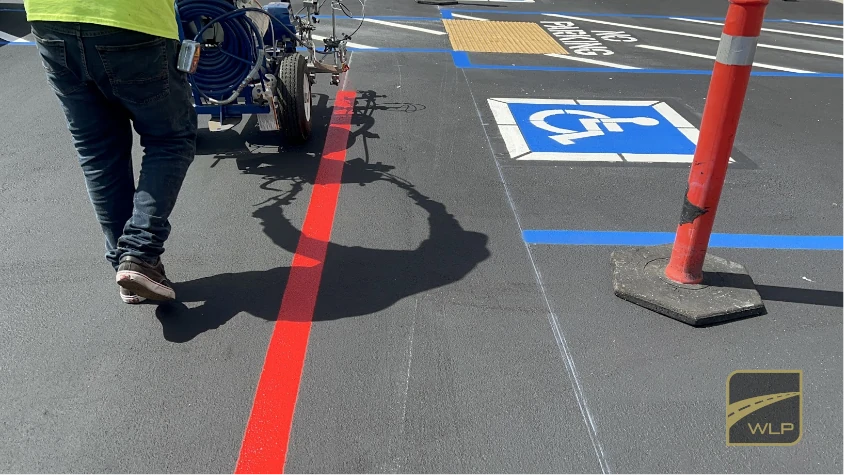
Effective commercial parking lot maintenance requires applying specialized thermoplastic or traffic-rated acrylic paints that withstand the regional climate. When WLP manages striping for high-volume retail centers, we assess the turning radius and frequency of delivery trucks to position yellow curbs where they minimize traffic bottlenecks. A poorly designed loading zone forces trucks to idle in the drive aisles, frustrating customers and slowing down operations.
Keeping your commercial property compliant and safe requires precise pavement markings that survive California’s weather and heavy usage. The field operations team at We Love Paving executes complete layouts, restriping, and ADA upgrades for commercial properties across the region. Connect with our team to schedule your parking lot striping in California and ensure your loading zones meet all state regulations.