Belgian chemist Edward de Smedt invented modern asphalt pavement in 1870, filing the first U.S. patents for a dense, aggregate-bound asphalt mixture. His paved demonstration outside Newark City Hall in New Jersey marked the transition from raw, naturally occurring bitumen to engineered road surfaces. While ancient civilizations harvested natural deposits for waterproofing, de Smedt engineered the specific proportion of aggregate, sand, and bitumen required to withstand heavy traffic.
Natural Asphalt vs. The Invention of Paved Roads
Natural asphalt occurs in geological lakes and rock formations, used as early as 620 BC in Babylon as mortar and waterproofing for canals and riverbanks. Sir Walter Raleigh famously documented the Trinidad Pitch Lake in 1595, using its natural bitumen to caulk wooden ships. However, using raw bitumen as a binding agent differed significantly from creating a stable roadway surface capable of supporting wheel loads.
The invention of paved roads required combining a flexible, viscous binder with graded aggregate particles that interlock under compaction. Before petroleum refining made liquid asphalt widely available in the early 20th century, early road builders relied on imported rock asphalt or natural lake pitch. By understanding what asphalt is composed of, engineers began replacing variable natural deposits with refined petroleum asphalt, standardizing binder viscosity and aggregate gradations for large-scale infrastructure.
Key Milestones in the Engineering of Asphalt Mixes
The transition from early patent pavements to dependable hot mix asphalt required key structural and testing innovations across two centuries:
- 1820s (Macadam Method): Scottish engineer John Loudon McAdam developed the principle of using angular, graded stone bases relying on compaction for mechanical strength, establishing the geometric foundation for modern road beds.
- 1870 (Sheet Asphalt Patent): Edward de Smedt combined Trinidad Lake asphalt with sand and heavy limestone dust, creating “sheet asphalt” used on Fifth Avenue in New York City and Pennsylvania Avenue in Washington, D.C.
- 1901 (Bitulithic Pavement): Frederick J. Warren patented “Bitulithic” pavement, introducing scientifically graded stone aggregates bound with asphalt to produce higher structural stability under heavy loads.
- 1930s (The Hveem Design Method): Francis Hveem, an engineer for the California Division of Highways (now Caltrans), invented the Hveem Stabilometer and Mix Design Method. This established quantitative testing for asphalt binder content and aggregate stability under wheel pressure.
- 1990s (Superpave System): The Strategic Highway Research Program (SHRP) developed the Superpave volumetric mix design and Performance Grade (PG) binder specification system, aligning mix formulation with climate extremes and traffic volume.
These engineering breakthroughs shifted paving from empirical trial-and-error to rigorous laboratory testing, forming the backbone of the modern asphalt paving process.
The Technological Evolution of Asphalt Paving
Explore how raw bitumen evolved into highly engineered, sustainable polymer mix pavements
Natural Bitumen Mortar & Waterproofing
Ancient Babylonians extracted raw asphalt seepages from natural deposits to bind brickwork and seal aqueducts along the Euphrates River, establishing bitumen’s fundamental waterproofing capabilities long before wheel-load engineering.
The Macadam Aggregate Base Foundation
Scottish engineer John Loudon McAdam replaced heavy stone foundations with angular, crushed aggregate bases compacted into dense layers. This geometric structural approach created load distribution foundations still used in modern pavement subbases.
The First Synthetic Sheet Asphalt Patent
Belgian chemist Edward de Smedt combined Trinidad Lake asphalt binder with sand and limestone dust, laying the first engineered sheet asphalt outside Newark City Hall, NJ. This formulation introduced precise binder-to-aggregate proportioning to roadways.
Bitulithic Graded Stone Pavements
Frederick J. Warren patented “Bitulithic” pavement, replacing sand-heavy sheet asphalt with scientifically graded stone mixtures. This aggregate interlock dramatically reduced binder quantity requirements while preventing summer instability under heavy horse-drawn and automotive loads.
The Hveem Mix Design & Testing Revolution
Francis Hveem of the California Division of Highways (now Caltrans) engineered the Hveem Stabilometer and Mix Design Method. This established quantitative testing for asphalt binder content, measuring plastic flow and stability under heavy commercial wheel pressure.
Sustainable Hot Mix, RAP & Polymer Binders
Today’s commercial asphalt combines high percentages of Reclaimed Asphalt Pavement (RAP), polymer-modified asphalt binders (SBS), and Warm Mix Asphalt (WMA) technologies. This approach reduces plant energy requirements while maintaining resistance to thermal cracking and rutting.
Self-Healing & Autonomous Infrastructure
The next frontier of pavement engineering incorporates steel fiber-infused self-healing asphalt activated by induction heating, microcapsule-sealed cracks, bio-based lignin binders, and embedded wireless charging coils for electric vehicles.
From Petroleum Refining to Sustainable Asphalt Mixes
The widespread adoption of the internal combustion engine in the early 1900s coincided with the growth of petroleum distillation. Refineries discovered that the heavy distillation bottoms asphalt binder offered uniform viscosity, consistency, and thermal response compared to natural lake bitumens. This technological shift enabled mass production of Hot Mix Asphalt (HMA), allowing cities to pave thousands of miles cost-effectively.
In recent decades, asphalt technology evolved to prioritize durability and environmental sustainability:
- Pavimento de asfalto reciclado (RAP): El asfalto moderno es el material más reciclado en América del Norte. El pavimento fresado se tritura y se vuelve a introducir en mezclas nuevas, reduciendo el consumo de agregados vírgenes y el uso de petróleo crudo sin comprometer la integridad estructural.
- Asfalto de mezcla tibia (WMA): Aditivos y tecnologías de espumado reducen las temperaturas de mezclado y colocación de 30 °F a 70 °F, disminuyendo el consumo de combustible en la planta y reduciendo las emisiones de gases de efecto invernadero.
- Modificación con polímeros: La adición de polímeros SBS (estireno-butadieno-estireno) o caucho de neumáticos reciclados (GTR) amplía el rango de rendimiento térmico de los ligantes asfálticos, evitando el ahuellamiento en altas temperaturas de verano y el agrietamiento en el frío invernal.
How Historical Innovations Shape Modern Paving Services
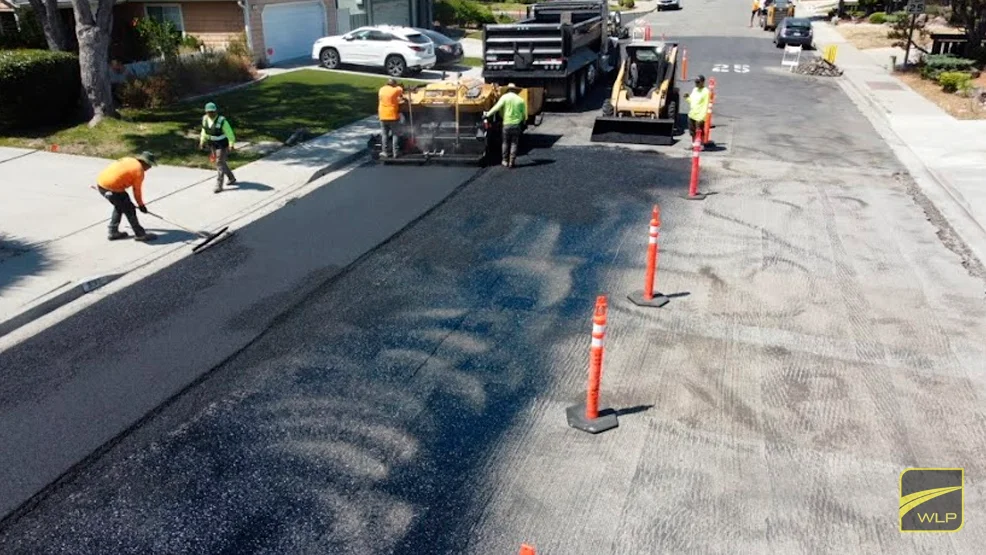
Modern asphalt pavements rely directly on testing standards and material chemistry introduced throughout the 19th and 20th centuries. Today, asphalt mixes utilize precise oil-to-aggregate ratios, dense-graded stone structures, and polymer-modified binders engineered to resist heavy axle loads, moisture damage, and thermal fatigue.
Understanding these historical principles ensures commercial property owners select appropriate pavement specifications for parking lots, industrial roadways, and high-traffic corridors. Applying proper subgrade compaction, aggregate gradation, and climate-matched asphalt binder grades guarantees that professional commercial asphalt paving services deliver durable, resilient surfaces built on over 150 years of engineering evolution.