A driver entering a parking lot makes several decisions before noticing the building: where the first row begins, whether the aisle is one-way, which stalls are open, where pedestrians might cross, and whether the painted zones should be avoided.
If the markings are clear, those decisions happen almost without thought. If the markings are faded or poorly placed, the driver slows down, guesses, or follows the behavior of whoever parked there first.
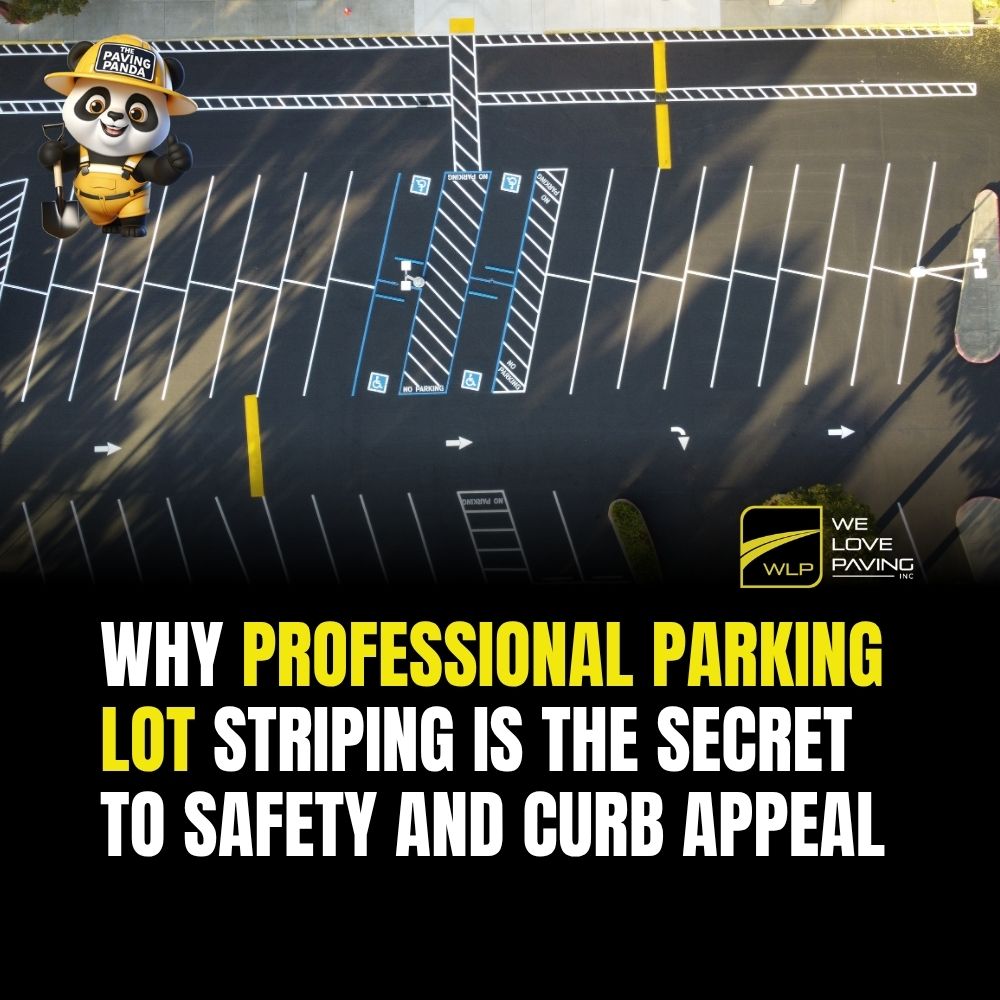
That is the simplest useful answer to what is parking lot striping: it is the pavement marking system that tells people how to use a parking lot before anyone has to explain it. Stall lines, arrows, crosswalks, loading zones, fire lane markings, curb paint, accessible parking symbols, and access aisles all turn open pavement into a readable space.
In Northern California, where commercial lots often serve retail tenants, medical offices, restaurants, service businesses, and office visitors in the same day, striping has to do more than look fresh. It has to make movement obvious.
The First Ten Seconds Decide Whether the Lot Feels Clear
A parking lot is judged quickly. Drivers do not stop at the entrance to study the layout. They look through the windshield and react.
If the entrance arrow is faded, they hesitate. If the first stall line is hard to see, the row begins to drift. If the crosswalk is weak, pedestrians choose their own route between cars. If the loading zone is unclear, a delivery van may stop where customers need to circulate.
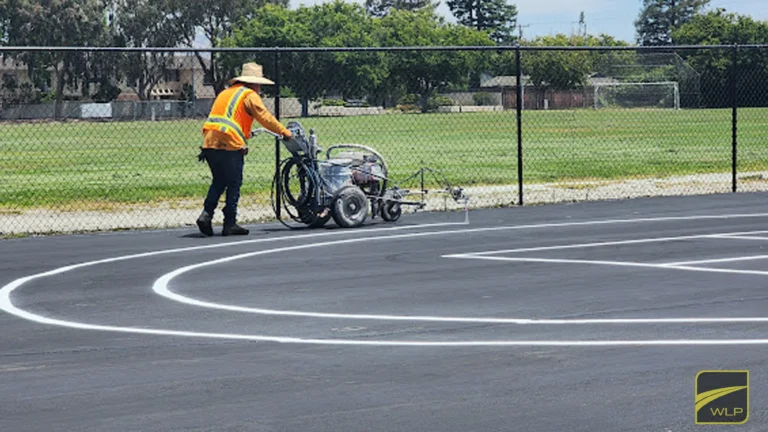
That is why parking lot striping should be treated as a working instruction system. It helps drivers make small decisions correctly: turn here, stop here, park inside this boundary, leave this area open, walk through this path.
The difference shows up fastest in busy properties. At a retail center, front-row stalls lose definition first because cars turn over constantly. At a medical office, access aisles and pedestrian markings carry more weight because visitors may rely on visible routes. At an office lot, visitor spaces must be obvious before someone circles twice and parks in a tenant-reserved area.
Paint does not make the property better by itself. It makes the property easier to read.
Fresh Paint Cannot Rescue a Confused Layout
Some lots have visible lines but still do not work well. That is a layout problem, not a paint problem.
A row may be striped too close to a tight turn. A delivery route may cut through customer parking. A crosswalk may point pedestrians toward a curb or landscape edge instead of a comfortable path. Visitor stalls may be mixed into employee parking so poorly that new arrivals never know where to go.
In those cases, repainting the same layout simply makes the old confusion brighter.
Striping works best when it matches the actual use of the site. Before repainting, a property owner should ask how the lot behaves during the busiest part of the day. Do cars stack near the entrance? Do customers park over faded stall lines? Do delivery trucks swing across painted boundaries? Do pedestrians ignore the marked path because another route feels more natural?
| What people do in the lot | What the striping may be failing to explain | What to review before repainting |
|---|---|---|
| Drivers pause at the entrance | Direction, aisle flow, or first-row position | Whether arrows and stall orientation match real traffic |
| Cars park unevenly in the front row | Stall boundaries or spacing | Whether faded lines or tight geometry are causing drift |
| Pedestrians cut between parked cars | Walking route or crossing location | Whether the marked path is visible and convenient |
| Delivery vans block a drive aisle | Loading or service area limits | Whether the service path is marked in the right place |
| Accessible aisles get blocked | Reserved space boundaries | Whether markings, signage, and layout need closer review |
The review does not need to turn every lot into a redesign project. Some properties only need clean repainting. Others need minor layout corrections before the paint goes down.
Striping Should Be Read From the Driver’s Seat and the Sidewalk
A parking lot looks different from a site plan than it does from a moving car.
From the driver’s seat, arrows, stall starts, stop bars, and curb markings need to be visible early enough to guide decisions. From the sidewalk, crosswalks, access aisles, and pedestrian paths need to feel predictable. From a delivery route, loading zones and no-parking areas need to be clear enough that drivers do not improvise.
Northern California lots often reveal this problem after sealcoating, resurfacing, or heavy seasonal wear. A darkened surface may look cleaner, but if markings are delayed or recreated poorly, the lot can feel unfinished. Dry summer glare can make weak lines harder to read. Winter rain can leave sediment near low markings, especially around curbs and drains.
This is where parking lot dimensions influence striping. Stall width, aisle clearance, parking angle, and turning movement affect whether the paint supports real driving behavior. A lot can have enough pavement area and still feel awkward if the markings force difficult turns or unclear pedestrian movement.
For access-sensitive areas, language should stay careful. Fresh markings may improve visibility and usability, but they do not guarantee ADA compliance or remove the need for professional review. An accessible parking layout may involve signage, pavement condition, routes, slopes, and local requirements beyond the paint itself.
Faded Lines Change Behavior Before They Disappear
A parking lot does not need fully missing lines to start malfunctioning.
Faded markings often change behavior gradually. One car parks slightly crooked. The next car copies it. A driver uses part of an old access aisle as extra space. A delivery vehicle stops along a faded curb zone because the restriction is no longer obvious. A visitor ignores a faint arrow and drives against the intended flow.
Those small choices become the unofficial layout.
This is why restriping timing should be judged by use, not only by color. If drivers are already hesitating, drifting, or parking inconsistently, the striping may be past its useful point even if the paint is still visible in daylight.
A property manager can spot the warning pattern without overcomplicating the inspection:
- cars no longer line up evenly in high-turnover stalls;
- arrows are visible only from certain angles;
- crosswalks fade where pedestrians actually walk;
- loading or fire lane markings are ignored more often;
- accessible access aisles need cones or reminders to stay open.
Those are not just appearance problems. They show the lot is losing its instructions.
Pavement Condition Decides How Well New Striping Holds
Striping should not be separated from the condition of the surface underneath.
Paint placed over loose aggregate, oily areas, failing patches, or rough cracked pavement will not wear the same as paint placed over a stable, clean surface. A line may look sharp on day one and begin breaking apart where the pavement is already raveling. A crosswalk may fade faster where water and grit move through the same low area after rain.
That is why pavement maintenance may need to come before striping. A lot with open cracks, soft patch edges, potholes, or heavy oil staining may need preparation before the markings are refreshed.
The sequence depends on the site. If the surface is sound and the markings are simply faded, restriping may be straightforward. If the lot is scheduled for sealcoating, resurfacing, or patching, striping should be planned after that work so the final layout is clear. If the existing layout no longer matches tenant use, the striping plan should be reviewed before anyone recreates the old lines.
The wrong sequence costs money twice: once to paint the lot, and again when the surface work or layout correction forces repainting.
Striping Is a Small Detail Until It Controls the Whole Experience
Parking lot striping is easy to underestimate because it looks simple from a distance. Up close, it shapes how the property works.
A customer deciding where to park, a patient looking for the nearest accessible stall, an employee entering before sunrise, a delivery driver searching for the correct service area, and a pedestrian crossing from the front row all depend on the pavement communicating clearly.
We Love Paving helps Northern California commercial owners review striping as part of actual site use, not just as fresh paint. On retail, office, medical, and mixed-use properties, the strongest striping plan is usually the one that answers the first question every user brings to the lot: where am I supposed to go?