Why do speed bumps exist? to physically enforce low vehicle speeds in areas where pedestrians and moving cars share tight spaces and where posted speed limit signs alone fail to slow drivers down. Rather than relying on a driver to notice a sign, check the speedometer, and voluntarily ease off the accelerator, a speed bump introduces a raised pavement profile that makes driving fast immediately uncomfortable.
In traffic engineering, this concept is known as self-enforcing road design. When a vehicle crosses a raised profile at 5 to 10 mph, its suspension compresses and rebounds smoothly. When that same vehicle approaches at 20 or 25 mph, the rapid upward displacement transfers a sharp jolt through the tires, suspension, and cabin. Drivers slow down not simply because a rule tells them to, but because the physical feedback of the roadway penalizes excess speed in real time.
At the same time, speed bumps are not universal tools that belong on every street or driveway. Effective traffic calming balances pedestrian protection against emergency vehicle response times, stormwater drainage across asphalt surfaces, and strict accessibility rules for people with disabilities. Understanding why these devices exist, and why their shapes vary so widely, clarifies how engineers and property managers keep shared pavement safe without creating new operational hazards.
Why Traffic Signs Alone Fail and How Physical Speed Control Works
Speed limit signs frequently fail in parking lots and neighborhood streets because drivers judge safe travel speeds based on the physical appearance of the road rather than the numbers printed on a metal post. Traffic engineers distinguish between posted speed (the legal limit) and design speed (the speed that feels natural given lane width, sightlines, and pavement smoothness). When a commercial parking lot features wide, freshly paved drive aisles, a 10 mph or 15 mph sign contradicts what the driver’s eyes see, leading most motorists to drift toward 20 or 25 mph without realizing it.
Attention limits compound this problem in low-speed environments. Inside a retail center, apartment complex, or school pickup zone, drivers divide their focus among scanning for open stalls, watching reversing vehicles, checking mirrors, and reading directional arrows. Under high cognitive load, monitoring a speedometer becomes a low priority, and passive regulatory signs easily blend into the visual background.
Physical speed control solves this gap through vertical deflection. When a tire climbs a raised asphalt or rubber profile, upward vertical acceleration compresses the vehicle’s coil springs and hydraulic dampers. At low speeds, the suspension has enough time to absorb the contour and keep the chassis relatively level. As approach speed rises, the dampers cannot dissipate the sudden upward energy fast enough, pitching the vehicle frame upward and creating an unmistakable physical jolt inside the cabin.
Because that mechanical response occurs consistently every time a vehicle crosses the device, vertical deflection acts as continuous, round-the-clock enforcement. Unlike speed cameras or patrol officers, a properly shaped pavement rise requires no power source or active monitoring to persuade drivers to decelerate before reaching a crosswalk or storefront.
The Specific Safety Risks Speed Bumps Are Built to Prevent
Speed bumps are built to reduce crash frequency and injury severity in locations where pedestrian movements are unpredictable and sightlines are partially obstructed. Vehicle stopping distance combines driver reaction distance with mechanical braking distance, and braking distance increases with the square of vehicle speed. A car traveling at 25 mph covers significantly more ground before coming to a complete stop than a car traveling at 10 mph, leaving far less margin when a pedestrian steps out from behind a parked vehicle.
Even when a collision cannot be avoided entirely, lowering impact speed dramatically reduces the kinetic energy transferred to a human body. Traffic safety research consistently shows that pedestrian survival rates drop sharply as vehicle impact speeds climb above 20 mph. By forcing vehicles down to walking or near-walking speeds ahead of high-conflict zones, raised profiles give both drivers and pedestrians extra fractions of a second to react.
In practice, property owners and municipalities install vertical speed control to address four distinct risk environments:
- Commercial parking lot drive aisles and storefront aprons: Retail centers concentrate foot traffic, shopping carts, and distracted drivers in narrow corridors where tall SUVs and delivery vans block lateral visibility between parking rows.
- School drop-off lanes and campus perimeters: Young pedestrians frequently enter travel lanes unexpectedly during concentrated morning and afternoon arrival windows, making consistent low speeds critical near curb zones.
- Residential cut-through streets: Commuters attempting to bypass congested arterial intersections often divert onto quiet neighborhood streets lined with driveways, parked cars, and children playing near sidewalks.
- Multi-family housing complexes and HOA communities: Private internal roadways combine tight blind corners, carport exits, and recreational foot traffic without dedicated municipal traffic enforcement.
Vertical devices target longitudinal speeding along straight stretches of pavement, though they do not solve every visibility hazard on their own. When blind intersections or faded crosswalks contribute to near-misses, raised profiles work best alongside clear pavement striping, curb paint, and unobstructed sight triangles.
Why Different Designs Exist: Speed Bumps, Speed Humps, and Speed Tables
Different raised traffic calming devices exist because a profile aggressive enough to slow cars to 5 mph in a parking lot would damage vehicles and disrupt traffic flow on a 25 mph residential street. How a vehicle reacts to a raised surface depends on two geometric measurements: vertical height and travel length (the distance the tire travels across the rise in the direction of traffic).
When the travel length is shorter than a standard vehicle’s wheelbase, the front and rear axles hit the obstacle separately, creating a sharp, abrupt rock. When the travel length extends to 12 feet or more, both axles ride up and over the contour gradually, producing a gentle vertical swell at moderate neighborhood speeds. Design manuals from the Institute of Transportation Engineers (ITE) and the Federal Highway Administration (FHWA) categorize these profiles by their geometry and intended operating speed:
Typical Dimensions
3 to 4 inches high;
1 to 3 feet long
Target Speed
5 to 10 mph
Application & Effect
Private parking lots and service alleys. Delivers a sharp, immediate jolt if crossed fast.
Typical Dimensions
3 to 3.5 inches high;
12 to 14 feet long
Target Speed
15 to 20 mph
Application & Effect
Local residential streets. Creates a smooth, rocking elevation for neighborhood speeds.
Typical Dimensions
3 to 3.5 inches high;
22 feet long
Target Speed
20 to 25 mph
Application & Effect
Collector streets. Accommodates longer wheelbases and functions as a crosswalk.
Typical Dimensions
3 to 3.5 inches high;
6 to 7 feet wide
Target Speed
15 to 20 mph
Application & Effect
Emergency corridors. Allows fire engines to straddle pads while slowing cars.
Selecting the wrong profile creates predictable operational problems. Installing a short, 2-foot speed bump on a public residential collector road forces drivers to brake abruptly from 30 mph down to 5 mph, increasing rear-end collision risk and generating neighborhood complaints. Conversely, placing a long 14-foot speed hump inside a compact retail parking lot leaves too little distance between stalls for drivers to feel any speed deterrent at all.
Engineering Trade-Offs: Why Do Speed Bumps Exist And Why They Are Not Installed Everywhere
Traffic engineers and facility managers avoid placing speed bumps on arterial roadways, major transit routes, and steep grades because every vertical obstacle introduces mechanical, acoustic, and operational trade-offs. The most critical constraint involves emergency response times. Fire engines, ladder trucks, and ambulances carry heavy equipment and patients on stiff commercial suspensions. Unlike a compact sedan, a fire apparatus must slow nearly to a complete stop to cross a traditional speed bump safely, adding several seconds of delay per bump that can accumulate along primary response corridors.
Acoustic impact and driver behavior also limit where raised profiles make sense. When speed bumps are spaced poorly or placed directly outside residential bedrooms, the repetitive sound of vehicles braking hard before the rise, suspension components compressing over the crest, and engines accelerating afterward creates noticeable noise pollution. In addition, drivers who repeatedly strike abrupt bumps above design speed accelerate wear on shock absorbers, struts, ball joints, and wheel alignment.
From a pavement engineering standpoint, poorly designed speed bumps threaten the structural integrity of asphalt. Rainwater relies on subtle cross-slopes to sheet off the driving surface into concrete gutters and storm drains. When an asphalt speed bump is paved continuously from curb to curb without drainage breaks, it acts like a dam. Water pools along the upstream edge of the bump, seeping into micro-cracks, stripping asphalt binder from the aggregate (a process called raveling), and softening the underlying base rock until potholes form right where tires impact the pavement hardest.
Visibility, Drainage, and ADA Compliance Requirements in California
In California, installing or upgrading speed bumps on commercial properties, HOA streets, or public roadways requires meeting strict visibility standards, protecting stormwater gutter flow, and keeping accessible pedestrian pathways completely unobstructed. Overlooking any of these three technical requirements exposes property owners to safety liabilities, premature asphalt deterioration, or costly accessibility corrections.
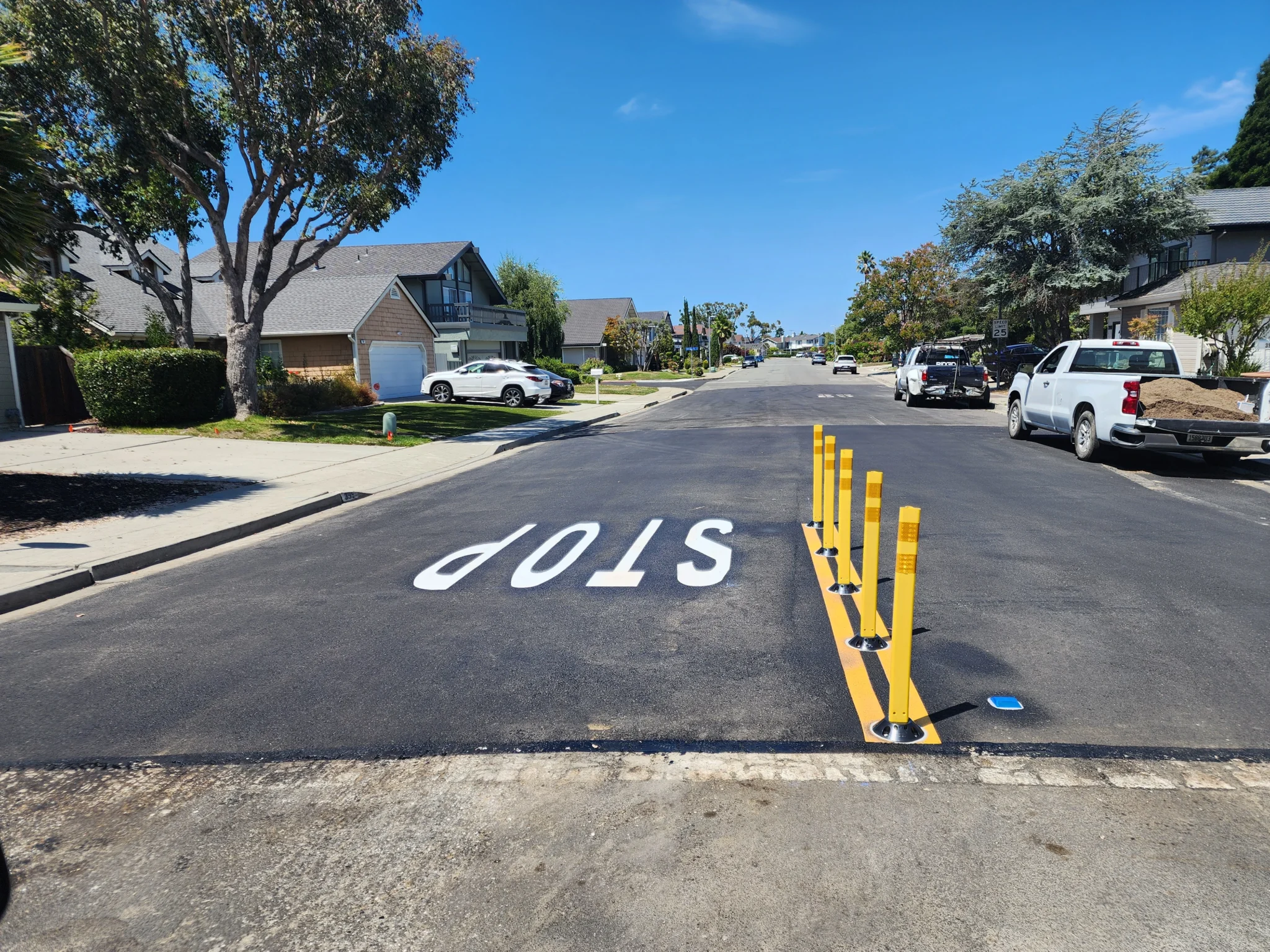
Visibility comes first under the California Manual on Uniform Traffic Control Devices (CA MUTCD), published by Caltrans. Unpainted asphalt bumps blend into the surrounding pavement at night, under tree shadows, or during low-angle sun glare, causing drivers to hit them at full speed or swerve unpredictably. Compliant installations pair high-visibility retroreflective pavement markings (such as yellow warning chevrons or transverse stripes) with advance warning signs (series W17-1) positioned ahead of the rise so motorists can decelerate smoothly.
Drainage preservation is equally vital during California’s concentrated winter rainstorms. Whether constructed from hot-mix asphalt or bolted recycled rubber, speed bumps should terminate short of the concrete curb and gutter pan, typically leaving a clear channel along the gutter line so runoff flows freely toward catch basins. Maintaining that gap prevents water ponding behind the bump and protects the pavement edge from moisture-induced cracking.
Accessibility law places strict boundaries on where raised devices can sit in commercial parking lots and multi-family communities. Under federal Americans with Disabilities Act (ADA) Standards for Accessible Design and Chapter 11B of the California Building Code, accessible pedestrian routes linking accessible parking stalls to building entrances cannot contain abrupt vertical level changes greater than 1/4 inch without a bevel (or 1/2 inch maximum with a 1:2 bevel) and must maintain cross slopes no steeper than 1:48 (approximately 2%). Placing a speed bump across a marked crosswalk or accessible path of travel creates an immediate barrier for wheelchair users and violates accessibility codes.
Before adding new speed bumps or resurfacing existing ones, property managers and HOA boards benefit from a site-specific pavement evaluation that checks drive-aisle sightlines, gutter drainage slopes, MUTCD striping visibility, and ADA path clearances together. Working with an experienced paving contractor, such as We Love Paving’s field operations team (CSLB Licensed #1049649, C12 Earthwork and Paving), helps ensure the chosen profile slows traffic effectively while protecting both pavement longevity and regulatory compliance across California properties.