Asphalt Calculator: Save Time and Budget Accurately
When planning an asphalt project, whether it’s a driveway, parking lot, or road, accuracy is key. Underestimating or overestimating the amount of asphalt needed can lead to unnecessary expenses or delays. That’s where an asphalt calculator comes in handy. This tool takes the guesswork out of the equation, helping you save time and stay on budget.
Why Use an Asphalt Calculator?
Accurate calculations are crucial in construction projects. Here’s why an asphalt calculator is a must-have:
- Saves Money: Avoid wasting resources by ordering the precise amount of asphalt needed.
- Speeds Up Planning: Get quick estimates without relying on manual formulas.
- Enhances Budget Accuracy: Plan your finances better with reliable cost estimates.
How Does an Asphalt Calculator Work?
The calculator uses a simple formula to estimate the asphalt volume and weight required:
Volume (cubic feet) = Area (length × width) × Thickness
Weight = Volume × Asphalt Density (145 lbs per cubic foot)
Inputs You’ll Need:
- Area Dimensions: The length and width of the project area (in feet or meters).
- Thickness: The desired depth of asphalt (in inches or centimeters).
- Asphalt Density: Typically 145 lbs/ft³ or 2,320 kg/m³.
San Jose Asphalt Guide: Thickness & Local Costs
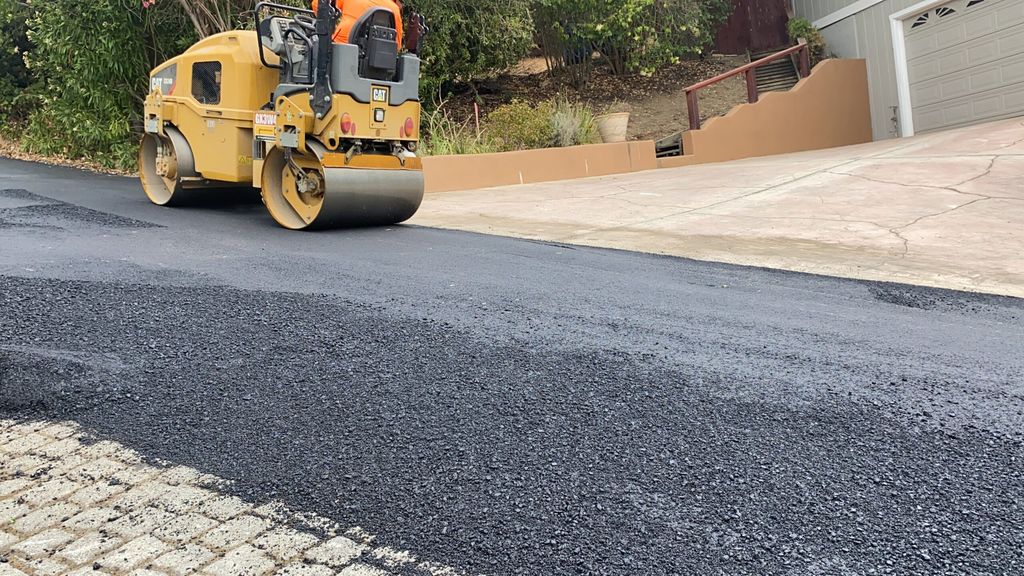
Before using the calculator, selecting the correct thickness for your San Jose project is critical to avoid structural failure. For a standard residential driveway, a 2-inch thickness of Hot Mix Asphalt (HMA) is generally sufficient. However, if you are paving a commercial lot or expect heavy vehicles, you must upgrade the depth to 3 to 4 inches. Keep in mind that this tool estimates the asphalt surface only, not the crushed stone subbase required by California paving standards. From a budget perspective, high-quality asphalt in the Greater Bay Area typically ranges between $85 to $110 per ton, excluding delivery and labor. Factoring in these local costs alongside accurate tonnage ensures your project is both durable and financially precise.
Example Calculation
For a 30 ft x 20 ft driveway with a thickness of 2 inches, the calculation is:
- Convert thickness to feet: 2 inches ÷ 12 = 0.167 feet.
- Calculate volume: 30 × 20 × 0.167 = 100.2 cubic feet.
- Calculate weight: 100.2 × 145 = 14,529 lbs (or about 7.3 tons).
With this information, you can place an accurate asphalt order!
Step-by-Step Guide to Using Our Calculator
- Enter Your Area Dimensions: Input the length and width of your project area.
- Select Thickness: Choose the desired depth of asphalt.
- Click Calculate: The tool will instantly provide the estimated asphalt volume and weight.
Common Applications
An asphalt calculator is perfect for:
- Driveways
- Parking lots
- Walkways
- Private roads
- Commercial paving projects
Tips for Better Accuracy
- Measure your project area carefully.
- Add 5-10% extra asphalt for irregular areas or compaction.
- Consult a professional for large-scale projects.
Plan Your Project With Confidence
Using an asphalt calculator simplifies your project planning, ensures you order the right materials, and helps you stay on budget. Ready to start? Try our free tool today and experience the difference accurate calculations make.