How Poor Drainage Undermines Asphalt From Below
Most asphalt failures don’t begin where you can see them.
They begin underneath the surface — slowly, quietly, and often unnoticed.
Poor drainage is one of the most damaging forces acting on parking lots, not because it looks dramatic, but because it weakens the pavement system from the ground up.
Asphalt Depends on a Stable, Dry Foundation
Asphalt pavement is designed to flex under traffic loads.
That flexibility only works when the base beneath it remains compacted and dry.
When water enters the pavement structure, the base layer begins to lose strength. Loads that were once distributed evenly are no longer supported properly, causing stress to concentrate in small areas.
The surface may still look intact, but its support system is already compromised.
Water Infiltration Is Inevitable
Asphalt is not fully waterproof.
Water enters through:
-
Hairline cracks
-
Construction joints
-
Porous surface areas
-
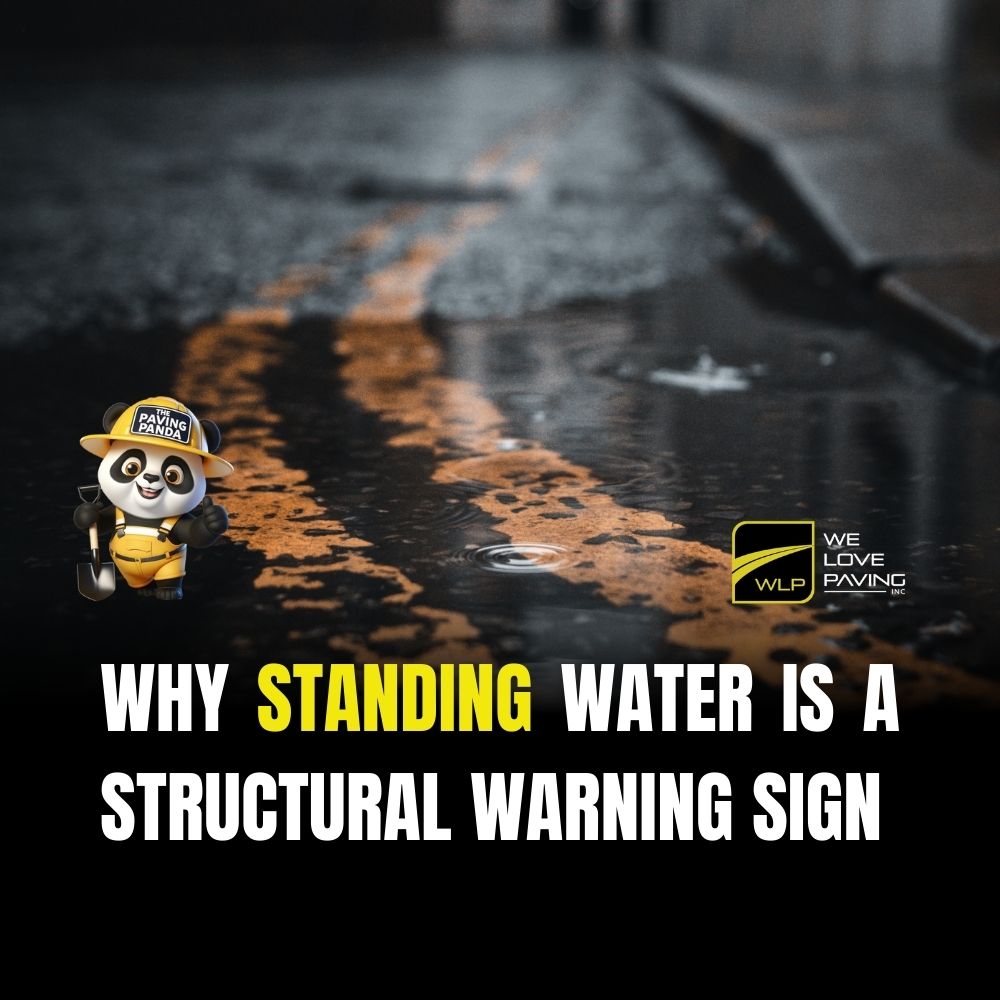
Low spots where water lingers
Once moisture reaches the base or subgrade, it drains slowly — if at all. Each passing vehicle applies pressure to a weakened foundation, accelerating internal movement.
Saturated Bases Lose Load-Bearing Capacity
A properly compacted base can handle repeated traffic.
A saturated base cannot.
Moisture reduces internal friction between base materials, allowing them to shift under load. Over time, this leads to:
-
Depressions forming in traffic paths
-
Cracks reflecting upward through the surface
-
Uneven settlement across the parking lot
These failures often appear gradual, but the structural damage progresses continuously.
Poor Drainage Accelerates All Other Pavement Damage
Drainage problems rarely act alone.
When the base is weakened:
-
Cracks spread faster
-
Surface raveling increases
-
Repairs fail sooner than expected
-
Striping fades unevenly due to surface movement
What begins as a drainage issue quickly becomes a structural maintenance problem.
Why Drainage Problems Are Often Overlooked
Drainage failures are easy to ignore because they aren’t always obvious.
Water may disappear hours after rainfall.
The surface may still appear serviceable.
Traffic may continue without complaint.
Because the damage occurs below grade, visual inspections alone rarely identify the real issue until surface failures become unavoidable — and expensive.
The We Love Paving Approach
We Love Paving evaluates drainage as a core structural factor, not an afterthought.
By understanding how water moves across and through a parking lot, early corrections can be made to protect the base, extend pavement life, and reduce long-term repair costs.
Final Thought
Asphalt doesn’t fail prematurely because it’s weak.
It fails when water undermines what supports it.
Addressing drainage early is one of the most effective ways to preserve pavement performance and avoid costly structural repairs later on.