🛑 Don’t Wait Until It’s Too Late: The Hidden Cost of Ignoring Your Parking Lot

Your parking lot is the first impression your business makes — and sometimes, the most dangerous part of your property.

Here’s what we see all the time:

  • Cracks become potholes.

  • Potholes become liabilities.

  • And liabilities… become lawsuits.

👀 What most property managers miss:
It’s not just about how it looks. Damaged pavement affects safety, accessibility, and your bottom line.

💰 Quick Fix vs. Big Bill

  • Crack sealing: $200–$500

  • Ignoring it until next season? Try $5,000+ in structural repairs.

📆 Summer is the time to take action.
Before rain, snow, and traffic wreak havoc again, let’s assess the damage and get your pavement back to business-ready condition.

📞 Book your free inspection today.
We’ll tell you what’s urgent, what can wait, and how to save money long term.

Why Summer Is the Best Time to Protect Your Pavement Before Winter Wrecks It

Summer isn’t just about sunshine and barbecues — it’s prime time to protect your pavement before the cold weather does irreversible damage.

Here’s why smart property managers and business owners take action now, not later:

☀️ 1. Ideal Weather = Ideal Results

Sealcoating and crack sealing require dry, warm conditions to properly cure. Summer offers the perfect environment for long-lasting protection. Try sealing in winter? It’s a recipe for wasted money and failed results.

💰 2. A Small Investment Now Prevents a Massive Bill Later

Cracks may look harmless today — but give them a few freeze-thaw cycles and they’ll turn into potholes. And potholes don’t just ruin cars — they can ruin your wallet.

  • Crack sealing now? $200–$500

  • Ignoring it till next season? $5,000+ in structural repairs and potential liability lawsuits.

🧑‍🦽 3. ADA Compliance and Safety Are Non-Negotiable

Uneven surfaces, faded lines, or missing ramps? Don’t wait until someone trips or files a lawsuit. Summer is the time to bring your property up to code and protect the people who visit it.

📆 4. Don’t Wait for the Fall Rush

By the time fall hits, every contractor’s booked out and prices go up. Beat the rush, secure better rates, and have your pavement ready before rain, ice, and snow do their worst.


Bottom line:
Summer maintenance saves you money, reduces liability, and protects your property’s first impression.

👉 Book your pavement assessment today with We Love Paving and get your lot business-ready before winter hits.

How to Prepare Your Parking Lot for Winter (And Avoid Expensive Repairs in Spring)

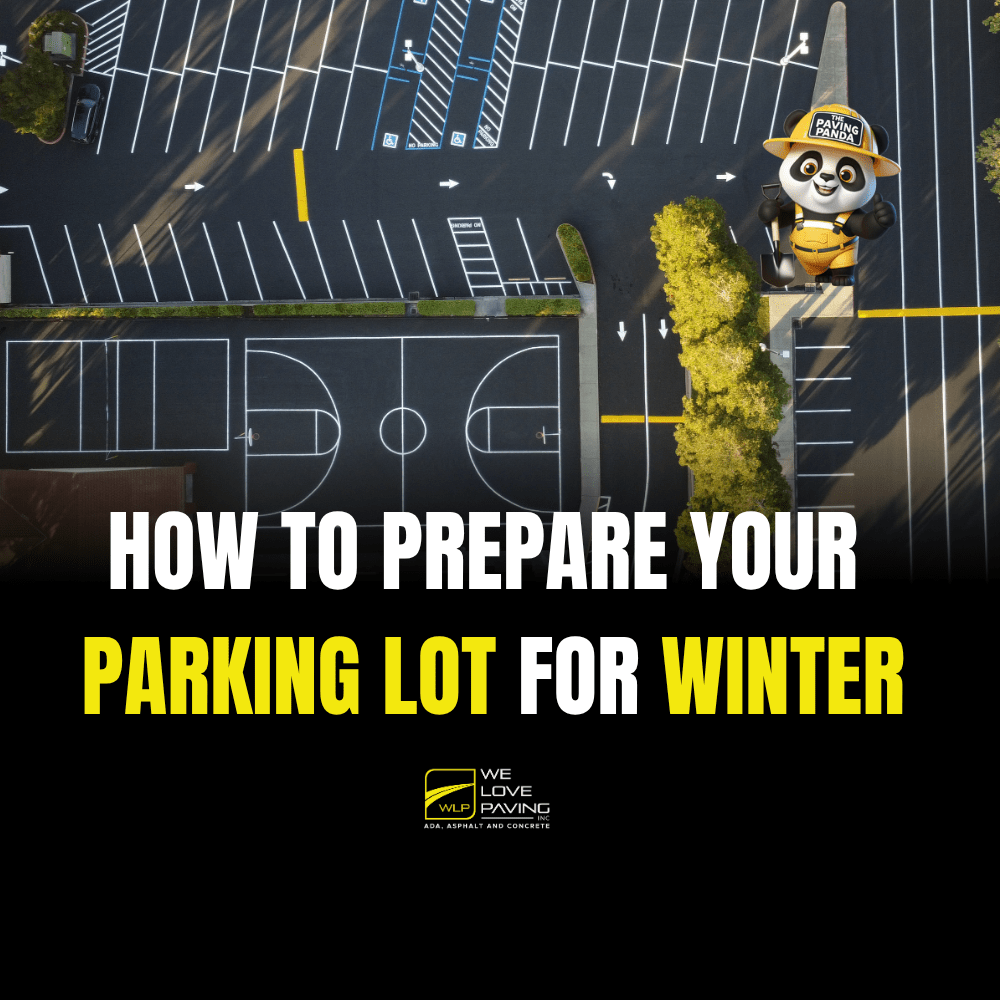
A clean and freshly striped parking lot with the WLP Paving Panda mascot and the text 'How to Prepare Your Parking Lot for Winter' by We Love Paving.

When winter rolls in, your parking lot is more vulnerable than you think.

At We Love Paving, we’ve seen firsthand how ice, snow, and freezing temperatures wreak havoc on asphalt and concrete surfaces. But here’s the good news: with a few strategic steps, you can protect your pavement, extend its lifespan, and avoid shelling out thousands in repairs come spring.

This is your Winter Prep Guide — everything you need to know to keep your pavement safe, functional, and looking great during the harshest months of the year.


🧊 Why Winter Is So Dangerous for Your Pavement

Cold weather isn’t just uncomfortable — it’s destructive.

Here’s what happens:

  • Water seeps into small cracks in your asphalt or concrete.

  • When temperatures drop, that water freezes and expands, making the cracks worse.

  • As this freeze-thaw cycle repeats, the damage grows exponentially.

  • By spring, you’re dealing with potholes, crumbling edges, or even structural failure.

This is especially true in high-traffic areas like commercial lots, shopping centers, HOAs, and apartment complexes.


🔍 Step 1: Inspect and Seal Cracks Now

Before the first freeze, walk your lot and look for:

  • Hairline cracks

  • Alligator cracking (spiderweb patterns)

  • Small depressions where water pools

  • Loose gravel or surface degradation

Early intervention is key.
Crack sealing is one of the cheapest forms of preventative maintenance — and one of the most effective.

💡 Pro tip: A crack sealing job in fall might cost you $300. That same neglected crack could cost you $3,000 to $5,000 in resurfacing if it turns into a pothole.


🚫 Step 2: Don’t Skip Sealcoating

Sealcoating is your pavement’s first line of defense.

It creates a protective barrier that resists:

  • Moisture infiltration

  • Road salt

  • UV damage

  • Oil stains

  • Daily wear and tear

When applied before winter, it locks in surface integrity and keeps your asphalt looking fresh and dark — even in freezing conditions.

⚠️ Important: Sealcoating can’t be applied in cold weather, so the window is short. Once temps drop below 50°F consistently, you’re out of luck until spring.


🚛 Step 3: Plan for Snow & Ice Responsibly

A poorly managed snow removal plan can destroy your lot faster than the snow itself.

Here’s what to do:

  • Mark your curbs, ramps, and islands with tall, visible flags or reflective tape before the first snowfall.

  • Use rubber-tipped plows or trained snow removal teams who know how to avoid scraping and gouging the surface.

  • Avoid over-salting, which accelerates surface erosion and contributes to long-term damage.

Don’t wait until it snows to figure this out — prep your contractors in advance.


🧼 Step 4: Keep It Clean

Debris, dirt, and oil stains aren’t just ugly — they weaken your pavement.

Before the first storm hits:

  • Power sweep the entire lot

  • Remove leaves and standing water

  • Degrease any oil or chemical spills

  • Clean out catch basins and storm drains

Standing water is a major threat in freezing weather, so make sure your drainage systems are working properly.


💰 Why This Matters: Cost of Prevention vs. Cost of Repairs

Issue Cost If Caught Early Cost If Ignored
Crack sealing $300–$500 $3,000–$7,000 (resurfacing)
Sealcoating $0.20–$0.30/sq ft $10+/sq ft (full-depth replacement)
Drain repair $800–$1,200 $5,000–$15,000 (flooded foundation)

When it comes to pavement, an ounce of prevention is worth a ton of reconstruction.


👷‍♂️ Partner With a Team That Knows Winter

At We Love Paving, we help property managers, business owners, and facility teams get ahead of the winter damage curve.

Whether it’s a routine inspection, a quick crack fill, or a full resurfacing before the cold sets in — we’re here to protect your investment.


📞 Ready to Winter-Proof Your Parking Lot?

👉 Schedule a FREE Winter Assessment
Let us walk your property, assess its condition, and recommend the right steps to keep it in top shape all season long.

🛑 Don’t wait until spring to deal with winter’s damage.
✅ Take action now — and save big later.

Why Small Asphalt Cracks Turn Into Big Problems (Fast)

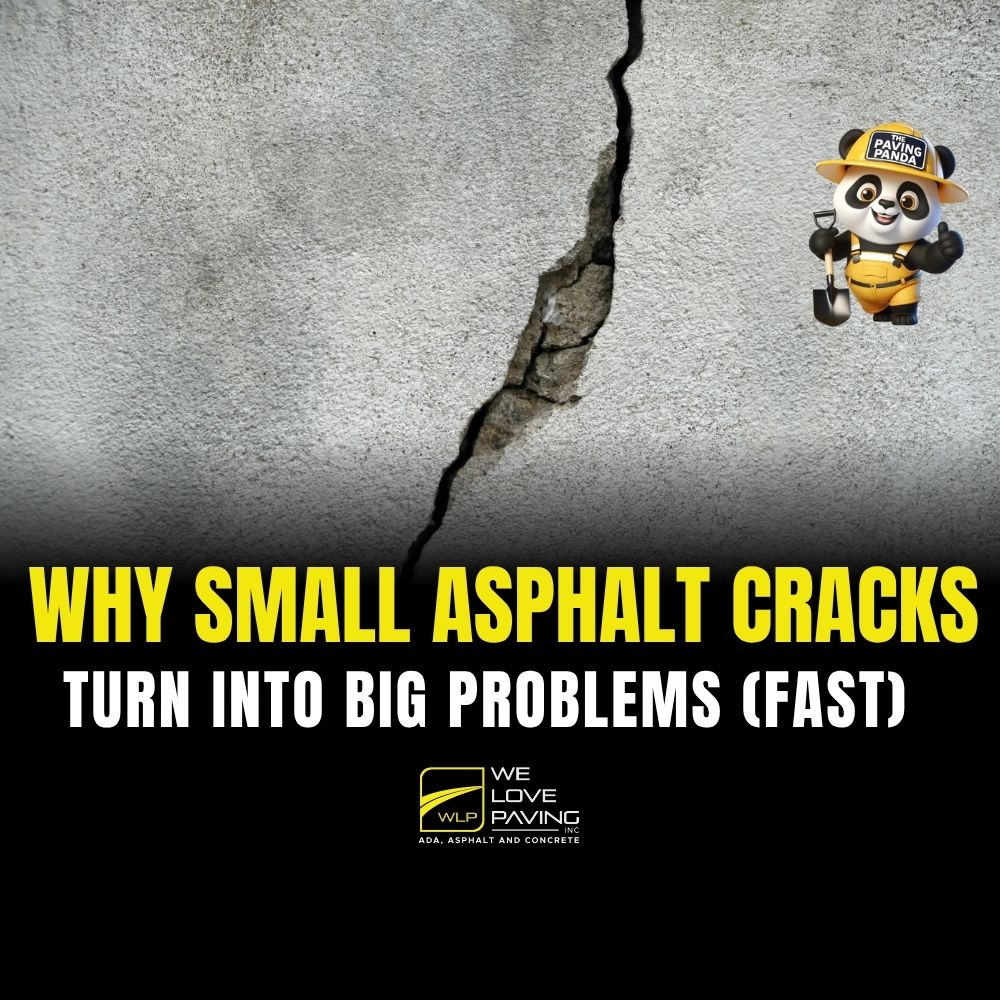
Infographic-style image showing a large asphalt crack with the headline "Why Small Asphalt Cracks Turn Into Big Problems (Fast)". Includes the We Love Paving logo and cartoon mascot "The Paving Panda"

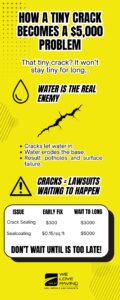
That tiny crack on your parking lot might not look like a big deal today. But give it a few months—and a couple of storms—and you’ll be dealing with a pothole the size of a tire. In asphalt, small problems don’t stay small for long.


🌧️ 1. Water Is the Real Enemy

Asphalt is durable, but it’s not invincible. Cracks let water seep in, eroding the base underneath. Over time, this creates:

  • Weak spots

  • Surface deformation

  • Full-blown potholes

Moisture + pressure = pavement failure.


🚗 2. Cracks Lead to Liability

Besides damage to the surface, cracks can cause:

  • Trip hazards for pedestrians

  • Tire damage for vehicles

  • Lawsuits from customers or tenants


💰 3. Preventative Maintenance = Major Savings

Investing early means saving big later.

Issue Early Fix Cost Delayed Repair Cost
Crack sealing $300 $3,000 (resurfacing)
Sealcoating $0.15/sq ft $5,000 (replacement)

🔍 4. What to Watch For

Here are early signs of surface failure:

  • Hairline cracks forming spiderwebs

  • Faded or oxidized surface

  • Standing water after rain

  • Loose gravel or surface raveling

If you see it—seal it.


👷 5. What We Do at We Love Paving

We offer full pavement evaluations, sealcoating, crack repair, and resurfacing.
Our team helps property managers stop damage before it snowballs.


📞 Conclusion / Call to Action

Don’t wait until it becomes a pothole problem.
Schedule a free assessment with our team and extend the life of your pavement—without blowing your budget.

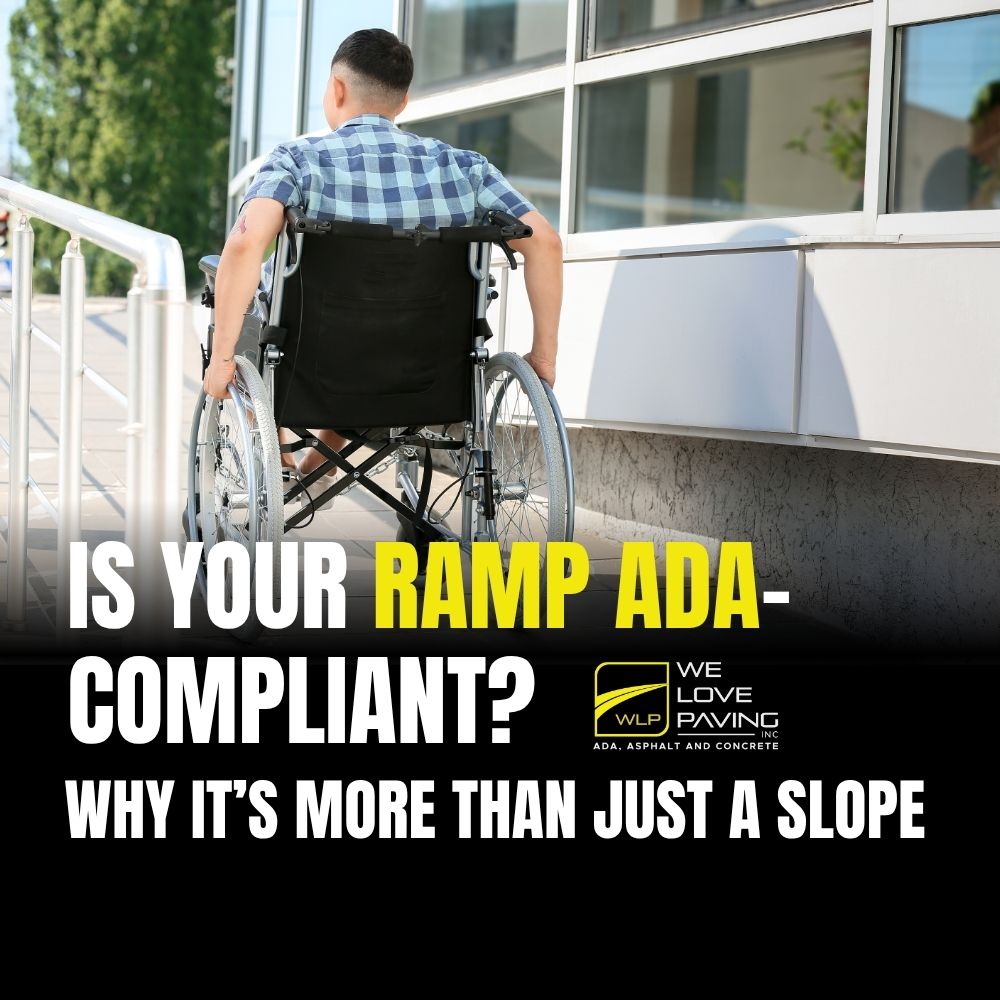
Is Your Ramp ADA-Compliant? Why It’s More Than Just a Slope

When most people think of ADA compliance, they imagine a simple ramp added to a curb or entrance. But the truth is: ADA-compliant ramps are one of the most overlooked — and most dangerous — features on a property when not built correctly.

At We Love Paving, we help property owners, HOAs, and commercial facilities ensure their ramps are fully compliant, safe, and built to code — not just to avoid lawsuits, but to truly protect people.


🔍 What Makes a Ramp ADA-Compliant?

It’s not just about having a ramp — it’s about having the right ramp. According to the Americans with Disabilities Act (ADA), ramps must meet specific guidelines, including:

  • Slope: No steeper than 1:12 (for every inch of rise, at least 12 inches of run)

  • Width: Minimum of 36 inches

  • Landing areas: Flat, level surfaces at the top and bottom

  • Handrails: Required on both sides if ramp rises more than 6 inches

  • Edge protection: Prevents wheels from slipping off

  • Slip-resistant surface: Especially critical in rain-prone areas

  • Clear space: No obstructions or sharp turns mid-ramp

Missing even one of these could make your property non-compliant — and open you up to serious risk.


⚠️ Real Risks of Non-Compliant Ramps

We’ve seen it too often:

  • A tenant in a wheelchair falls due to improper slope ➜ personal injury lawsuit

  • A business fined $30,000+ for ramps without handrails

  • A small HOA forced to rebuild all ramps after a single ADA complaint

Even if no one’s been hurt — yet — that doesn’t mean you’re safe. ADA inspectors and lawyers don’t wait for accidents to enforce compliance.


💰 Proactive Compliance Saves You Thousands

Investing in a compliant ramp isn’t a cost — it’s protection:

✔ Avoid lawsuits and settlements
✔ Prevent costly rebuilds
✔ Ensure accessibility for all visitors
✔ Increase trust and value in your property


🧱 How We Help at We Love Paving

We don’t just build ramps — we engineer solutions that pass inspection and keep people safe. Our ADA ramp services include:

  • Full site inspection and compliance audit

  • Removal and replacement of non-compliant ramps

  • Concrete pouring with proper slope and drainage

  • Installation of handrails and edge protection

  • Truncated domes for tactile warnings

  • Striping, signage, and barrier-free access coordination

Everything we do is to code, to spec, and on time.

Want to make sure your ramp is fully ADA-compliant as part of the entire accessible route? Check out ADA Compliance: It’s Not Just About Ramps, Folks! — a detailed guide that covers slopes, landings, handrails, transitions, and real-world violations that trigger lawsuits.


✅ Final Thoughts

If your property has a ramp — but you’re not sure if it meets ADA standards — you’re at risk.
Let’s fix that before it becomes a problem.

📞 Schedule a free ADA ramp inspection today and protect your property, your people, and your peace of mind.

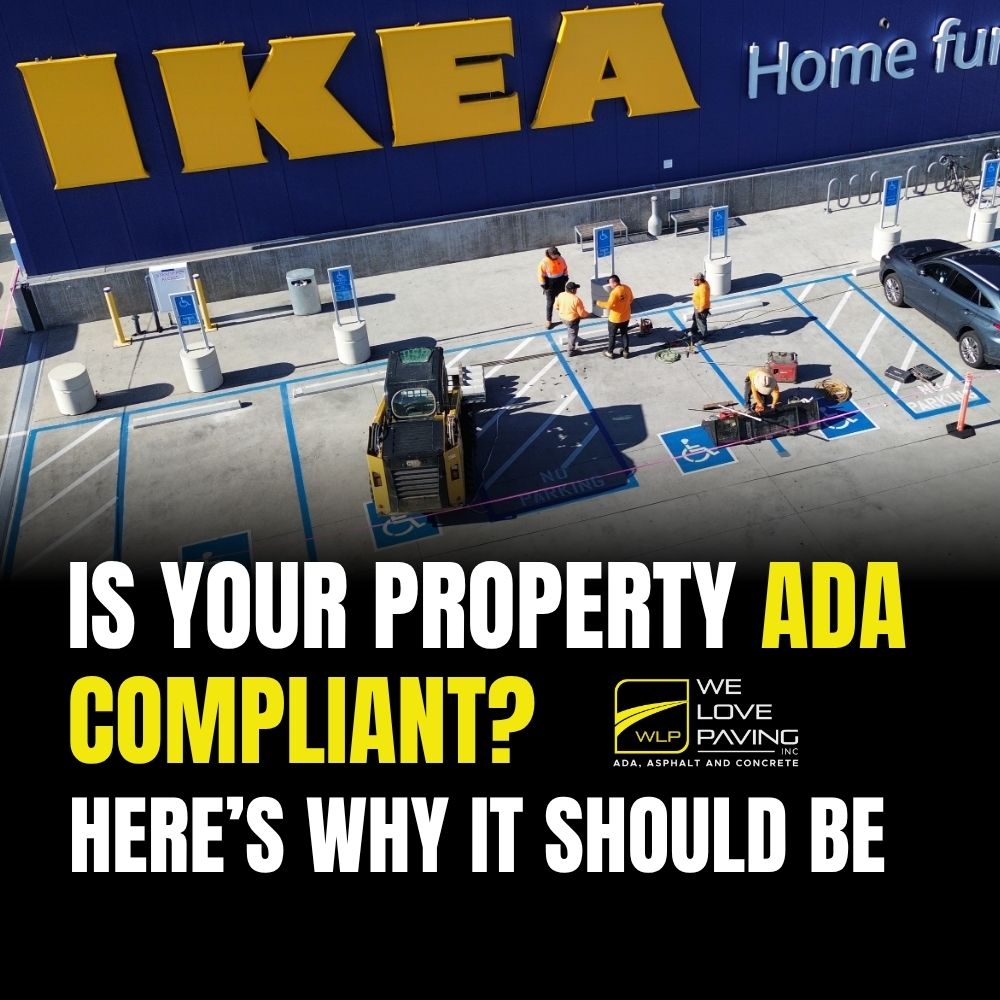
Is Your Property ADA Compliant? Here’s Why It Should Be

ada compliance

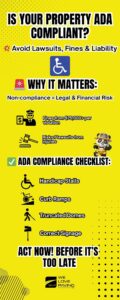
If your parking lot or entrance isn’t ADA compliant, you could be risking more than just fines — you could be putting people in danger and your business at legal risk.

At We Love Paving, we help property owners, HOAs, and business managers upgrade their spaces to meet ADA standards — and avoid costly lawsuits in the process.


What Is ADA Compliance?

ADA (Americans with Disabilities Act) compliance means ensuring your property is safe and accessible for people with disabilities. This includes:

  • ✅ Proper handicap parking stall striping

  • ✅ Accessible curb ramps and landings

  • ✅ ADA-compliant signage and height placements

  • ✅ Truncated domes for visual and tactile warnings

  • ✅ Handrails and barrier-free access routes

Failing to meet these standards can result in fines starting at $75,000 per violation — and much more if someone is injured due to negligence.


Real-World Consequences of Non-Compliance

We’ve seen it happen:

  • A commercial plaza fined over $20,000 for improper signage

  • A small business owner sued after a visitor tripped on a non-compliant ramp

  • An HOA forced to redo its entire parking layout after a resident complaint

The truth? Ignorance is not a legal defense.


Benefits of Proactive ADA Upgrades

Making your property ADA-compliant is more than just following the rules — it’s about:

  • 🙌 Creating inclusive spaces for all visitors

  • 💰 Avoiding lawsuits and expensive retrofits

  • 📈 Increasing property value and trust


How We Can Help

At We Love Paving, we don’t just fix issues — we prevent them. Our team will:

  1. Inspect your property for ADA compliance gaps

  2. Recommend cost-effective, legally sound solutions

  3. Complete all necessary work — from signage to striping to concrete ramps


Final Thoughts

ADA compliance isn’t optional — it’s the law.
But more importantly, it’s a sign that your business cares about accessibility, safety, and doing things right.

📞 Contact us today for a free ADA compliance assessment.

The Cost of Waiting: Why Delaying Pavement Repairs Is More Expensive Than You Think

At We Love Paving, we talk to property managers, business owners, and homeowners every week who say the same thing:

“I was planning to fix it later… now it’s 10x worse.”

cost of pavement repairs

Unfortunately, when it comes to asphalt and concrete, time is your enemy.

Small Problems Become Big Liabilities

  • A hairline crack today can turn into a full pothole within weeks.

  • A slightly uneven ramp can lead to ADA violations and lawsuits.

  • A faded parking lot with poor striping can cause accidents — and legal trouble.

What could have been a simple fix becomes a major repair job that costs you thousands — or worse, your reputation.

The Financial Truth: Preventative Maintenance Saves You Money

Here’s a basic comparison:

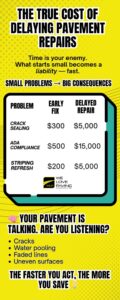
Problem Early Fix Cost Delayed Repair Cost
Crack Sealing $300 $5,000 (resurfacing)
ADA Compliance Fix $500 $15,000 (lawsuit + reconstruction)
Striping Refresh $200 $3,000 (accident liability)

Your Pavement Is Talking — Are You Listening?

Most pavement damage gives warning signs:

  • Cracks

  • Water pooling

  • Faded lines

  • Uneven surfaces

The faster you respond, the more you save.

Don’t Wait for a Lawsuit or a Sinkhole

If you’re unsure about the condition of your pavement, let our team at We Love Paving help you. We provide:

✅ Free site assessments
✅ Honest, expert recommendations
✅ Cost-effective repair plans

📞 Contact us today and protect your pavement — and your budget — before it’s too late.

The Hidden Dangers of Ignoring Pavement Cracks

At first glance, a few cracks in your pavement might seem harmless — just a cosmetic issue. But beneath the surface, they could be causing serious damage.

Water seeps in. Temperatures change. And before you know it, that small crack becomes a pothole, or worse — structural failure.

At We Love Paving, we’ve seen it all:
✅ Commercial parking lots with thousands in damage due to unchecked cracks
✅ Residential driveways crumbling after one rainy season
✅ Business owners forced to repave entire lots because they waited too long

The truth?
Crack sealing is one of the most affordable, effective ways to protect your pavement and extend its life by years.

Don’t wait for the damage to grow.

Whether it’s asphalt or concrete, commercial or residential — our team is ready to inspect, repair, and protect your property.

📞 Contact us today for a free assessment and learn how a simple crack repair can save you thousands down the road.

Why Pavement Maintenance Is the Smartest Investment for Property Owners

When it comes to property management, many owners focus on interior renovations and landscaping. But what about the surface your customers drive and walk on every day? Your pavement is one of the first impressions people get of your business — and one of the most overlooked assets when it comes to maintenance.

At We Love Paving, we’ve seen how a simple maintenance plan can save our clients thousands of dollars and extend the lifespan of their asphalt by years.

The Real Cost of Neglect

Pavement isn’t just a surface — it’s a system. Underneath that smooth blacktop are layers that control drainage, load-bearing, and safety. Cracks, potholes, and standing water are signs that deeper damage may already be happening. And the longer you wait, the more expensive the repairs become.

In fact, every $1 spent on routine maintenance can save $4–$10 in costly repairs later, according to industry studies.

What Smart Owners Are Doing

More and more business owners are turning to proactive solutions like:

  • Sealcoating every 2–3 years to protect against oxidation and water penetration

  • Crack filling to prevent moisture from expanding and weakening the subbase

  • Line striping to keep parking areas safe and ADA-compliant

  • Full resurfacing every 15–20 years for high-traffic commercial areas

These strategies not only extend the life of your pavement, they also boost curb appeal and show customers you care about quality and safety.

WLP’s Promise to Property Owners

We don’t just lay asphalt — we build long-term relationships. Our team works with commercial, industrial, and residential clients to design custom maintenance plans based on traffic flow, drainage needs, and climate conditions.

Whether you’re managing a retail plaza, apartment complex, or warehouse, we’ll help you protect your investment with solutions that are affordable, fast, and built to last.


Need expert advice on your pavement? Contact We Love Paving today and get a free on-site evaluation.

The Engineering Behind Durable Asphalt Pavement

What truly makes a pavement last—and why shortcuts cost more in the long run.

At We Love Paving, durability isn’t luck—it’s engineering. Every parking lot, driveway, or road we build is a system of layers, compaction, slope, and drainage working together to withstand load, time, and climate.

This article breaks down the technical components that separate long-lasting pavement from premature failure, helping property owners and project managers understand the “why” behind every layer we install.


📏 1. Subgrade Evaluation and Stabilization

The subgrade is the native soil that supports the pavement system. If it’s weak, expansive, or poorly compacted, the surface above it will fail—no matter how thick the asphalt is.

Our Process:

  • Proctor compaction tests to determine ideal moisture and density

  • Subgrade compaction to 95%+ using heavy rollers

  • Soil stabilization (lime, cement, or geogrid fabric) for expansive or wet soils

  • Moisture conditioning if needed

💡 A poorly prepared subgrade is the most common cause of alligator cracking.


🧱 2. Aggregate Base Design

The aggregate base distributes the load from the pavement surface to the subgrade. Its depth and material type vary based on traffic volume, soil type, and project use.

WLP Specs:

  • Class II AB (crushed rock) installed at 4″–12″ depth

  • 100% crushed, angular aggregate for better interlock

  • Layered compaction in 2″ lifts to 95%+ density

  • Slope engineered to 1–2% for surface water flow

We also design reinforced bases for dumpster pads, loading zones, and heavy-use areas using concrete collars or thicker base sections.


💧 3. Drainage and Surface Water Management

Water is the #1 threat to pavement. Without proper drainage, the base layer erodes, leading to subgrade saturation and failure.

WLP Drainage Solutions:

  • Crowned or cross-sloped surfaces (min 1%)

  • Curb and gutter tie-ins with drainage basins

  • Trench drains or French drains for high-volume areas

  • Edge support to prevent lateral water infiltration

🛠️ In mountain or coastal regions, we also recommend subdrain systems to control groundwater pressure.


🛣️ 4. Asphalt Layer Design

The surface asphalt must balance flexibility, load-bearing strength, and resistance to environmental factors like UV, oil, and thermal expansion.

Our Asphalt Specs:

  • Caltrans-approved hot mix asphalt (HMA)

  • Installed in 2–3 lifts depending on thickness

  • Compacted to 92–96% relative density

  • Mix design tailored to project type (e.g., commercial vs. residential)

We also use PG binders suited for local climate zones and aggregate gradation matched to expected traffic.


♿ 5. ADA Compliance Built Into Geometry

Proper slope, grade breaks, and transitions are essential for both safety and ADA compliance.

WLP ADA Engineering Includes:

  • Max 2% cross slope on accessible routes

  • Proper placement of truncated domes and curb ramps

  • ADA stall layout according to Title 24 and federal specs

  • Formwork, elevation checks, and signage during final walkthrough

We design ADA compliance into the plan set—not after the pour.


🔁 6. Post-Construction Maintenance Strategy

Even well-built pavement needs a lifecycle plan. Without sealcoating, crack repair, and re-striping, environmental exposure will degrade your surface.

WLP Maintenance Plans:

  • Sealcoat every 2–3 years

  • Crack sealing annually (or as needed)

  • Surface inspections at 6–12 month intervals

  • Refresh ADA markings and signage


🧠 Final Word: Durable Pavement Is Engineered—Not Estimated

A pavement’s longevity is not about the thickness of asphalt alone. It’s about the entire system: soil, base, drainage, slope, materials, and long-term planning.

At We Love Paving, we bring engineering precision to every inch—so your pavement performs like it should.


📞 Need a technically sound quote?

Let our team walk your site and develop a custom pavement design based on soil conditions, traffic loads, compliance needs, and your budget.

👉 Request your free evaluation today at welovepaving.com
Or call (888) 273-0077