Parking lots don’t suddenly fail.
They send warning signs long before major repairs become unavoidable.
The problem is that many of these signs are easy to ignore — until costs, liability, and disruption escalate.
If you manage a commercial property, recognizing early pavement issues is one of the simplest ways to protect your budget and your asset.
1. Cracks Are Becoming More Frequent
A few isolated cracks are normal.
But when cracking becomes widespread or starts connecting, it’s a sign the pavement is losing structural integrity.
Cracks allow water to enter the asphalt base.
Once that happens, deterioration accelerates from below the surface.
If cracks are multiplying, pavement care is already behind schedule.
2. Water Pools After Rain
Standing water is never cosmetic.
If water remains on the surface more than 24 hours after rainfall, it indicates drainage issues or surface deformation.
Over time, pooling water leads to:
-
Potholes
-
Subbase failure
-
Accelerated surface wear
-
Increased ADA exposure
Water is asphalt’s biggest enemy — and one of the clearest warning signs.
3. The Surface Looks Gray, Dry, or Brittle
Healthy asphalt has flexibility and resilience.
When it turns gray, dry, or brittle, oxidation has already begun.
This means the asphalt binder is breaking down, making the surface more prone to cracking and raveling.
At this stage, sealcoating can still slow deterioration — but timing matters.
4. Patching Is Becoming More Frequent
Occasional repairs are normal.
Repeated repairs in the same areas are not.
When patching becomes routine, it often signals underlying structural issues that haven’t been addressed.
Without a broader maintenance plan, patches become temporary fixes instead of long-term solutions.
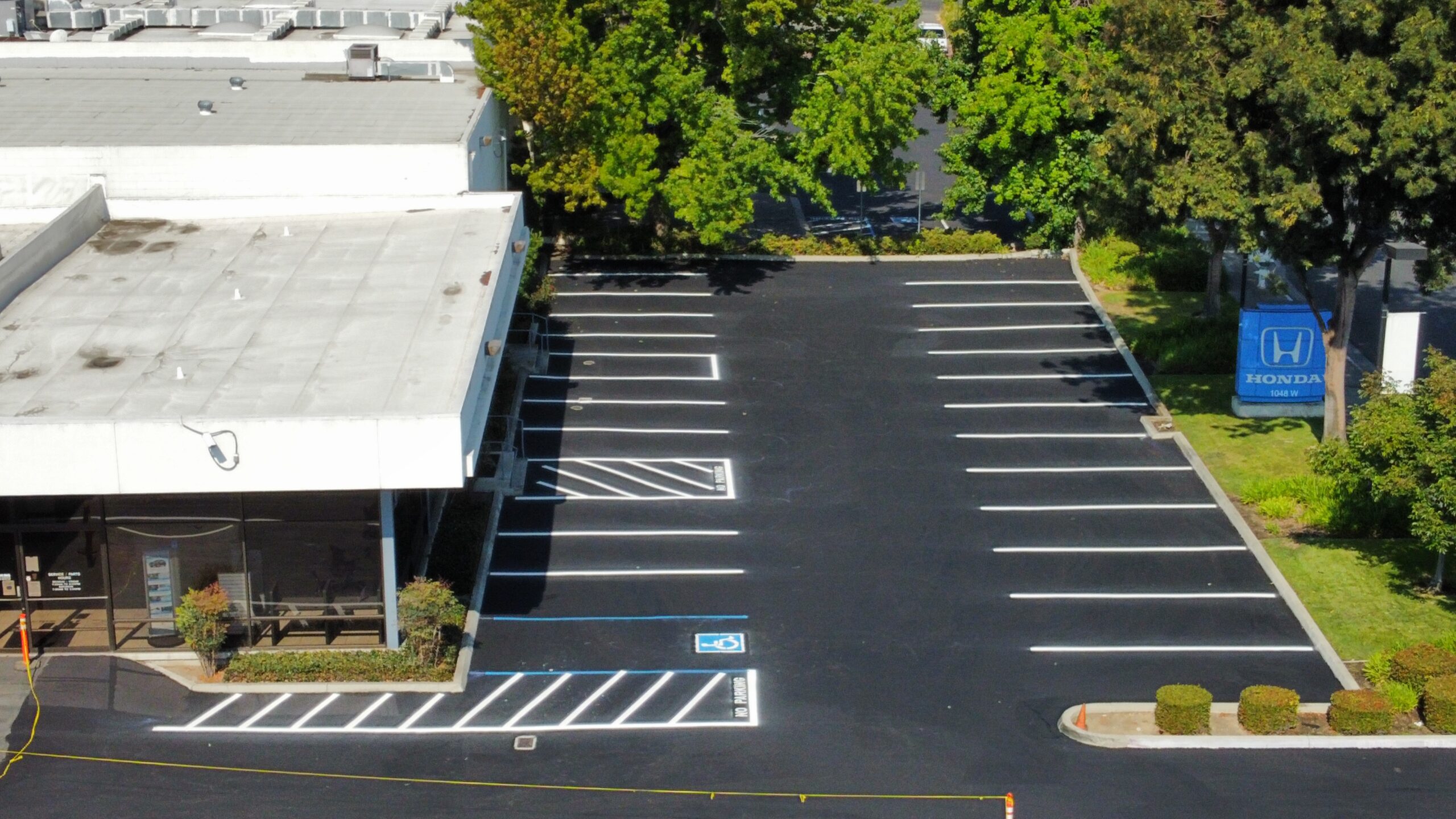
5. Striping Is Faded or Inconsistent
Faded striping is more than a visual issue.
Clear markings are critical for:
-
Traffic flow
-
Pedestrian safety
-
Fire lane visibility
-
ADA compliance
When lines are hard to see or inconsistent, safety risks and liability exposure increase — even if the pavement itself appears intact.
6. Small Issues Are Being Deferred
If maintenance decisions are consistently postponed because the lot “still works,” the property is likely falling behind.
Deferred maintenance compounds damage.
Each missed cycle reduces the effectiveness of future repairs and increases total lifecycle cost.
Waiting rarely saves money.
7. Maintenance Is Reactive, Not Planned
Emergency calls and last-minute repairs are a clear signal that pavement care is reactive.
Reactive maintenance typically results in:
-
Higher costs
-
Limited repair options
-
Increased disruption
-
Unpredictable budgets
Planned maintenance restores control and predictability.
Why Early Action Matters
Preventive maintenance costs a fraction of full replacement.
Well-maintained parking lots:
-
Last significantly longer
-
Reduce liability risks
-
Improve curb appeal
-
Protect property value
Most major asphalt failures are preventable with timely intervention.
The We Love Paving Perspective
At We Love Paving, we help properties identify issues early and act before costs escalate.
Our approach focuses on:
-
Pavement assessments
-
Preventive maintenance planning
-
Targeted repairs
-
Long-term asset protection
We help property managers stay ahead of pavement deterioration — not react to it.
Don’t Wait for Failure
If you’re noticing one or more of these signs, the best time to act is now.
📩 Contact We Love Paving to schedule a pavement assessment and build a maintenance plan that keeps your property protected and predictable.