Introduction
Designing or managing a parking lot isn’t just about painting lines — it’s about compliance, efficiency, and safety.
In this updated 2025 guide, we’ll cover the exact parking space dimensions in feet, including standard, compact, and ADA-accessible spots, to help property owners and facility managers ensure proper layout and compliance with California and U.S. regulations.
1. Standard Parking Lot Dimensions in Feet
What’s the Average Parking Space Size?
- Single Car Space: 9 feet wide x 18 feet long (standard).
- Compact Car Space: 8 feet wide x 16 feet long.
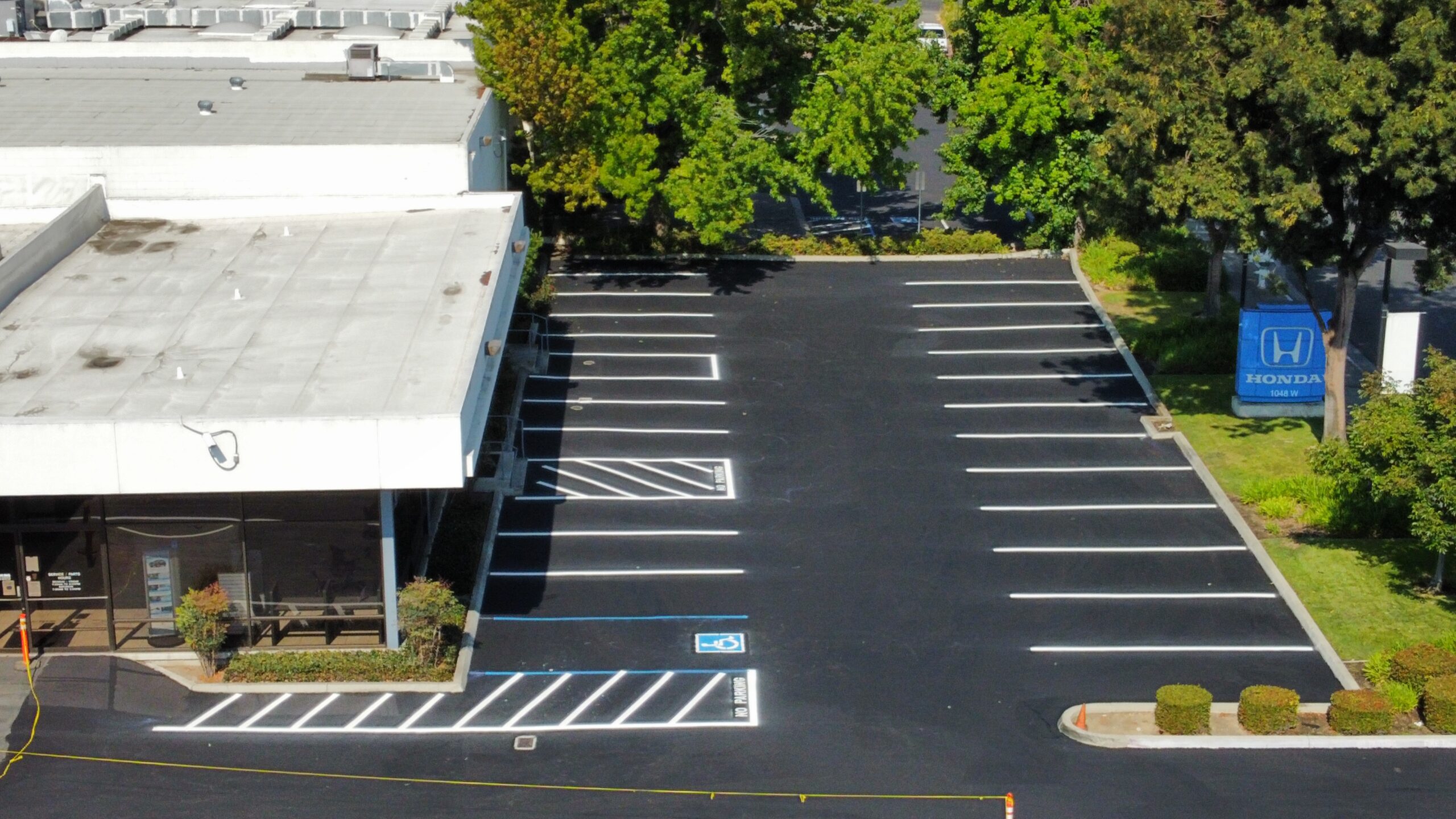
- Handicap/Accessible Spaces: 12 feet wide x 18 feet long (with 5-foot access aisle).
Aisle Widths:
- One-way aisles: 12–15 feet wide.
- Two-way aisles: 20–24 feet wide.
Angled Parking:
- 30° angle: 12-foot aisle width.
- 45° angle: 13-foot aisle width.
- 90° angle (perpendicular): 24-foot aisle width.
(Keywords: “parking space size in feet,” “aisle width in feet”)
2. Factors Affecting Parking Lot Dimensions
a. Local Regulations
- Cities and states have specific codes (e.g., fire lane requirements, setbacks). Always check local ordinances.
b. Vehicle Types
- Trucks/SUVs: Require 10-foot-wide spaces.
- Electric Vehicles (EVs): Need space for charging stations (additional 3–4 feet).
c. ADA Compliance
- Accessible spaces: Must comprise 2% of total spaces (for lots with 25+ spaces).
- Van-accessible spots: 12-foot-wide space + 8-foot aisle.
(Keywords: “ADA parking space dimensions,” “parking lot regulations”)
3. How to Calculate Parking Lot Dimensions in Feet
Use this formula to estimate total parking lot size:
- Total Spaces: Determine the number of vehicles (e.g., 50 cars).
- Space Size: Multiply by standard dimensions (e.g., 50 x 9ft x 18ft).
- Aisle & Driveway Space: Add 20–30% for aisles and circulation.
Example:
A 50-space lot with 9x18ft spaces + 24ft two-way aisles ≈ 12,000–15,000 sq. ft.
(Keywords: “calculate parking lot size,” “parking lot layout in feet”)
4. Design Tips for Efficient Parking Lots
- Minimize Dead Space: Use angled parking to maximize capacity.
- Landscaping: Add islands (8–10ft wide) for aesthetics and drainage.
- Signage: Ensure clear markings (6-inch-wide lines) for traffic flow.
- Future-Proofing: Plan for EV charging stations or expanded capacity.
(Keywords: “parking lot design tips,” “optimize parking lot space”)
5. Common Mistakes to Avoid
- Ignoring Drainage: Slope parking lots 1–2% to prevent pooling.
- Overcrowding: Avoid narrowing aisles below 12 feet.
- Poor Lighting: Space light poles 30–40 feet apart for safety.
FAQs About Parking Lot Dimensions in Feet
Q: What is the minimum parking lot size for 10 cars?
A: For 10 standard spaces (9x18ft) + 24ft two-way aisles: ~3,000–3,500 sq. ft.
Q: How wide should parking lot entrances be?
A: 24–30 feet for smooth traffic flow.
Q: Are parking lot dimensions the same for residential vs. commercial?
A: Commercial lots often require larger spaces (10ft wide) for trucks.
📐 How Big Is a Parking Spot?
If you’ve ever wondered how big a parking spot actually is, here’s a breakdown of standard dimensions across the U.S.:
| Type of Space | Width (Feet) | Length (Feet) | Example Use |
|---|---|---|---|
| Standard Spot | 9–10 ft | 18–20 ft | Most properties |
| Compact Spot | 8–8.5 ft | 16–18 ft | Small vehicles |
| Parallel Spot | 8 ft | 22–24 ft | Curbside or street parking |
| ADA Spot | 8 ft + 5 ft aisle | 18 ft | Handicap spaces |
| Truck/Oversized | 10–12 ft | 20–24 ft | Heavy-duty use |
🧱 Note:
Parallel spaces often need 22–24 ft in length to allow proper entry/exit without collisions. Add 2–3 extra feet for clearance.
Parking Lot Drive Aisle Width Standards
When designing a parking lot, the drive aisle width is one of the most important layout elements to get right. Aisles that are too narrow cause turning conflicts, slow circulation, and potential property damage — while overly wide aisles waste valuable space.
The required width depends mainly on three factors:
-
The parking angle (45°, 60°, 75°, or 90°)
-
The direction of travel (one-way or two-way)
-
Local building and fire codes, which may require additional clearance
Here are the most common industry-standard aisle widths used by engineers and paving contractors across California and the U.S.:
| Parking Angle | One-Way Aisle Width | Two-Way Aisle Width | Recommended For |
|---|---|---|---|
| 45° | 12–14 ft (3.6–4.2 m) | 22–24 ft (6.7–7.3 m) | Small lots, limited space |
| 60° | 14–16 ft (4.3–4.9 m) | 22–24 ft (6.7–7.3 m) | Retail centers, offices |
| 75° | 18–20 ft (5.5–6.1 m) | 24–26 ft (7.3–7.9 m) | High-traffic areas |
| 90° | 20–24 ft (6.1–7.3 m) | 24–26 ft (7.3–7.9 m) | Commercial & industrial lots |
Pro tip: The minimum parking lot drive aisle width for two-way traffic should never be under 24 feet, especially in commercial or ADA-accessible facilities.
In ADA-compliant layouts, wider aisles ensure vehicles have enough space to access designated accessible stalls safely. The California Building Code and ITE Parking Generation Manual both recommend a minimum 24-foot two-way aisle for standard parking configurations.
Proper aisle design improves:
-
Vehicle maneuverability
-
Pedestrian visibility
-
Emergency and delivery access
-
Overall parking efficiency
If your property layout is tight or nonstandard, it’s best to have a paving engineer verify compliance before striping. Proper aisle widths not only prevent accidents but also reduce long-term maintenance issues caused by tight turning paths.
🧭 Angled vs. Perpendicular Parking
| Layout | Angle | Width | Aisle Requirement |
|---|---|---|---|
| Angled | 45° | 9 ft | 12–14 ft (one-way) |
| Angled | 60° | 9 ft | 16–18 ft (one-way) |
| Perpendicular | 90° | 9–10 ft | 22–26 ft (two-way) |
✅ Angled parking is best for high-turnover commercial areas like malls or offices.
Perpendicular layouts fit more cars but need wider aisles.
🧩 Design Notes for California
California’s parking standards typically require:
-
1 ADA spot per 25 spaces minimum
-
Van-accessible spaces with 8 ft aisle
-
2% max slope for ADA compliance
-
Reflective thermoplastic paint for striping durability
⚙️ Why Proper Dimensions Matter
-
Prevents congestion and accidents
-
Meets ADA and city requirements
-
Increases property value and appeal
-
Improves navigation and safety for visitors
Conclusion
Understanding parking lot dimensions in feet is essential for compliance, safety, and usability. At WeLovePaving, we specialize in designing and paving lots that maximize space and durability. Contact us for a free consultation to plan your perfect parking lot!