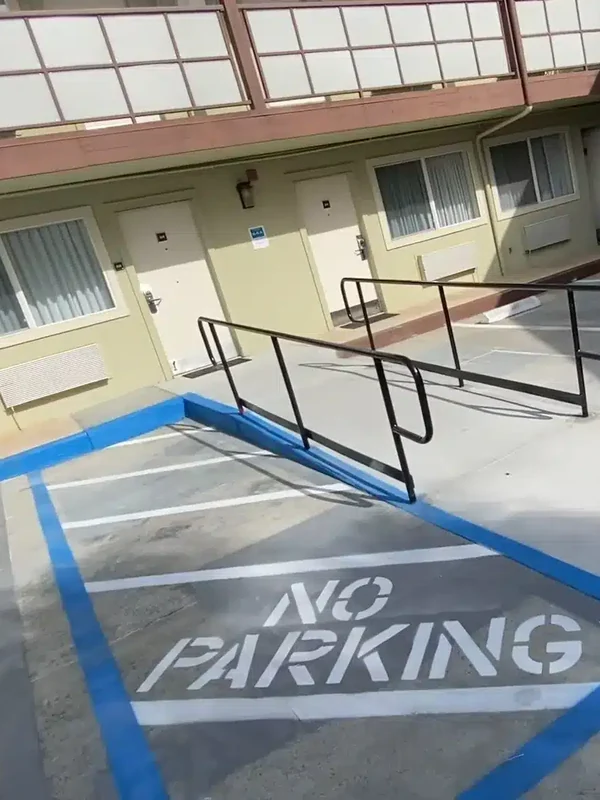
Handicap Parking Laws for California Apartments California
Accessible mobility infrastructure is not merely a legal obligation; it is a pillar of modern civil engineering. In California, precision in slopes and tactile signage defines a property’s viability

INFORMATIONAL RESOURCE
What You’ll Find On This Page
Implementing parking zones for users with reduced mobility requires detailed topographical analysis. Our approach integrates asphalt durability with the geometric precision necessary to comply with California’s Title 24.
Slope Precision (Grading)
We execute surfaces with a maximum slope of 2.0% in any direction, utilizing laser scanning technology to prevent water ponding and ensure wheelchair stability.
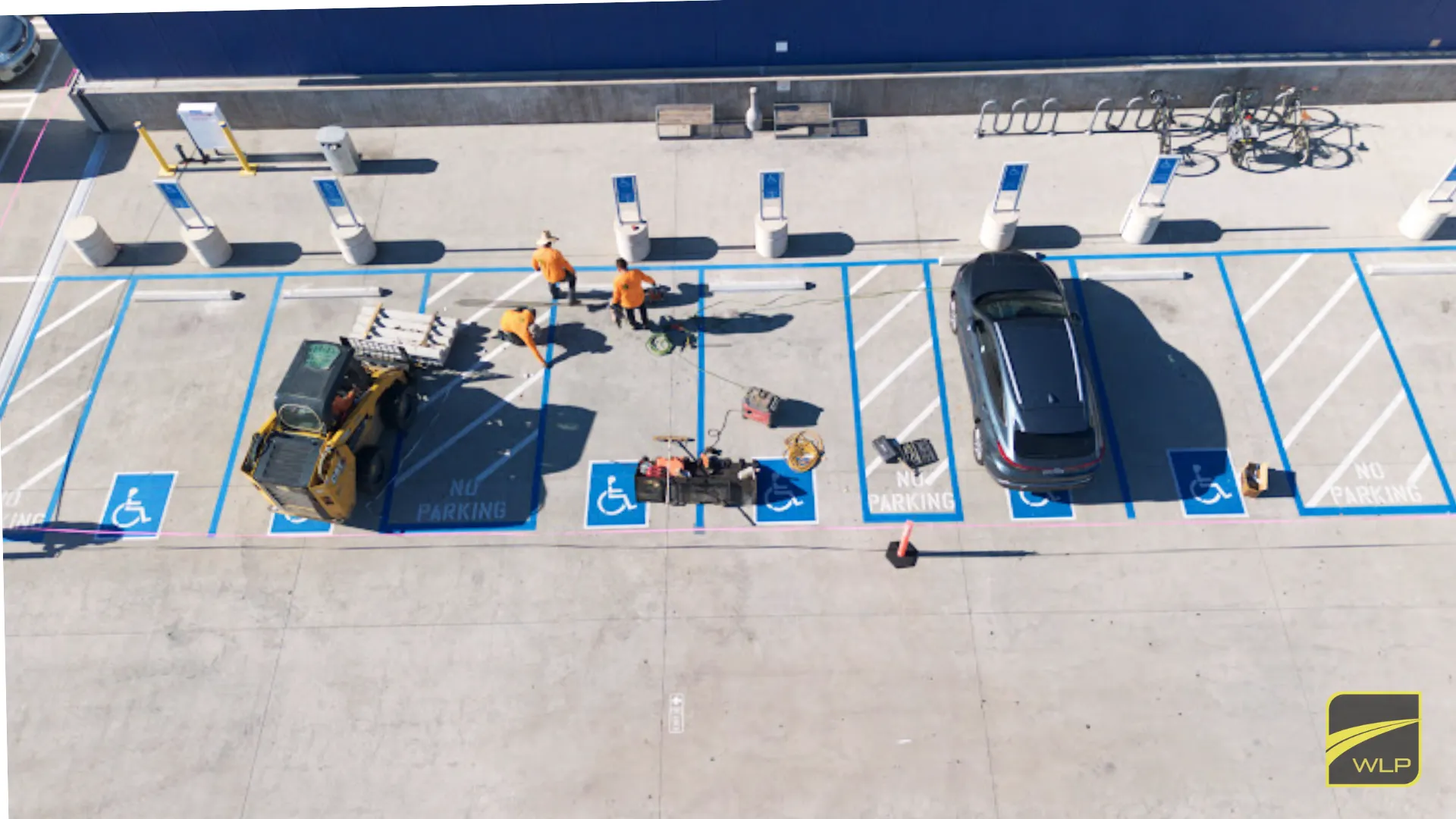
High-Visibility Thermoplastic
We apply industrial-grade coatings and international symbols of accessibility with materials that resist friction wear and UV degradation.
Access Route Configuration
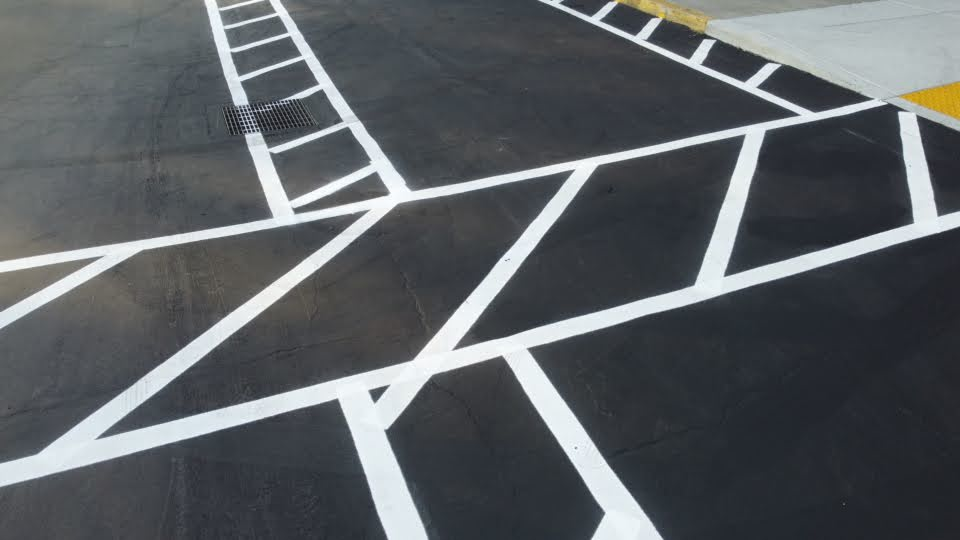
We design access aisles adjacent to parking spaces, ensuring that the connection with curb ramps is fluid and free of structural obstacles.
Load Optimization and Structural Resilience
The design of a parking area must consider the impact of parking lot for heavy delivery traffic. It is not just about the surface layer; the base and sub-base must be calculated to support logistics vehicles without compromising the integrity of accessible spaces. A structural failure in these areas can invalidate regulatory compliance.
Risk Mitigation and Operational Safety
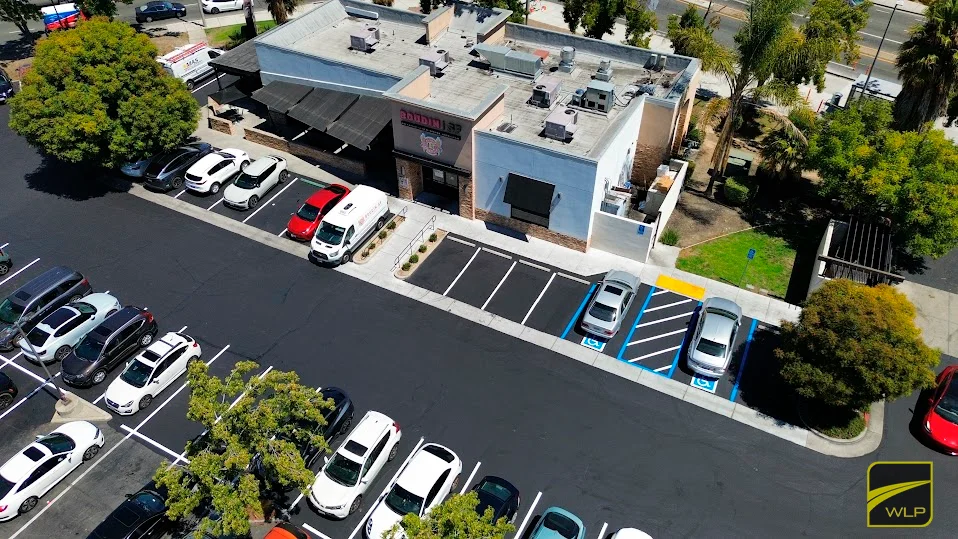
Maintaining a property liability-free status requires constant vigilance over cracks, potholes, and unevenness in handicap zones. At We Love Paving, we back every intervention with The Panda Pledge, our quality commitment that ensures every square foot meets the most demanding safety expectations in the market.
Design Geometry and Dimensioning
Correct application of parking space dimensions is critical in California. This includes a minimum width of 9 feet for standard vehicles and 12 feet for accessible vans, always accompanied by a 5 or 8-foot loading aisle as appropriate. Precision in these measurements prevents sanctions and improves the end-user experience.

KEY HIGHLIGHTS
Important Elements to Extract From the Resource
This page is designed to present information in a clear, easy-to-scan format, making it simple to find key insights, understand the content, and take action with confidence.
Reflective Identification
Each space must have vertical signage at a minimum height of 80 inches, featuring the International Symbol of Accessibility in white on a blue background.
Truncated Domes
The installation of yellow tactile surfaces at transition points between the sidewalk and asphalt is mandatory for visual safety.
Preventive Sealcoating
Sealcoating is not just aesthetic; it protects accessibility signage from oxidation and maintains the visual contrast necessary for safe navigation.
Turning Radius
Site design must allow specialized transport vehicles to operate without obstructing main circulation paths.
KEY HIGHLIGHTS
Secure Your Regulatory Compliance Today
Do not let poor grading or obsolete signage put your property’s integrity at risk. Our California experts are ready to audit and optimize your paving areas with engineering precision

FAQ
Frequently Asked Questions
Quick answers to the questions we hear most about this topic.
The number depends on the facility’s total capacity. Generally, for every 25 total spaces, at least one accessible space is required. If the property has between 501 and 1,000 spaces, the calculation becomes more complex following a strict proportional table. Technically, in multi-unit facilities in California, Title 24 (CBC) must be met, requiring at least one accessible space to be “Van Accessible” for every six required accessible spaces.
The maximum slope allowed in any direction for an accessible parking space and its access aisle is 2.0%. Exceeding this limit is considered an accessibility violation. In engineering practice, this requires superior drainage control to prevent water ponding, which could cause slip hazards or difficulties for users with assistive devices.
A “Van Accessible” space must have a minimum width of 12 feet if the access aisle is 5 feet wide, or a width of 9 feet if the access aisle is 8 feet wide. These measurements ensure that the side ramps of specialized vehicles can deploy fully on a level surface, guaranteeing a safe transition from the vehicle to the main access route.
Yes, California requires each space to be identified with a sign showing the International Symbol of Accessibility. These must be at a minimum height of 80 inches from the ground to the bottom of the sign. Additionally, an extra “Van Accessible” sign is required for the corresponding spaces and a warning of minimum $250 fines for unauthorized use.
Surface irregularities can be grounds for liability lawsuits and administrative sanctions. A surface must be stable, firm, and slip-resistant. Regular maintenance through sealcoating and technical patching is essential to prevent small imperfections from becoming architectural barriers that hinder the safe mobility of users.
Heavy traffic can cause subsidence and asphalt fatigue, altering critical 2.0% slopes. If delivery trucks circulate near handicap areas, it is vital to reinforce the sub-base and use high-performance asphalt mixes to preserve the geometric leveling required by law and avoid costly future structural repairs.
READY TO GET STARTED?
Download the complete PDF or request a technical audit with no obligation.